


 PLATFORM UPDATE:

A highly selective SBA-15 supported fluorescent “turn-on” sensor for the fluoride anion†
Abstract
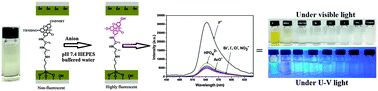
In an effort to improve the performance of organic-based F− receptors, organo-silica receptors are being developed taking advantage of the large surface area that mesoporous silica offers. In this work, we investigated the possibility of using a simple “piece-wise” assembly method to immobilize silyl-ether protected fluorescein isothiocyanate (FITC) molecules (receptor 1) on the surface of 3-aminopropyltrimethoxysilane (APTES) and 3-[2-(2-aminoethylamino)ethylamino] propyltrimethoxysilane (APAEAETMS) modified SBA-15 to form sensors ASBA and TSBA, respectively. We showed that aqueous solutions of TSBA (or ASBA) produce distinct changes in absorption and emission spectra upon F− addition due to the F− directed cleavage of Si–O bonds on receptor 1. TSBA (or ASBA) remained stable upon prolonged exposure to UV light (losing ∼0.12% of its fluorescence intensity), and was highly selective towards F− over other common anions (Cl−, Br−, I−, HPO42−, ACO−, and NO3−). Furthermore, the sensitivity of this type of sensor architecture followed a dependence on the kind of amino-silane compound used, which opens up the possibility of synthesizing sensors with tailored detection limits. The detection limit of TSBA and ASBA was 0.02 μM and 0.5 μM, respectively.
 Please wait while we load your content...


