


 PLATFORM UPDATE:

Nitrogen-doped CeOx nanoparticles modified graphitic carbon nitride for enhanced photocatalytic hydrogen production†
 a
a
Abstract
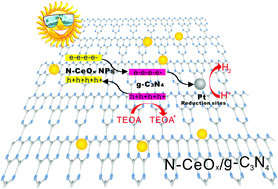
Nitrogen-doped CeOx nanoparticles (N-CeOx NPs) were directly formed on graphitic carbon nitride (g-C3N4) via a facile one-pot method by annealing a mixture of Ce(NO3)3 and melamine as CeOx and g-C3N4 precursors, respectively. Nitrogen was in situ doped into CeOx under NH3 atmosphere released by the decomposition of melamine during the annealing process. The physical and photophysical properties of N-CeOx NPs modified g-C3N4 photocatalysts were investigated to reveal the effects of N-CeOx NPs on the photocatalytic activities of g-C3N4. It was found that the one-pot annealing method was favorable for forming intimate interfacial contact between N-CeOx and g-C3N4. The visible light photocatalytic hydrogen production activity over g-C3N4 was enhanced by ca. 1.2 times with the N-CeOx NPs modification. The significant enhancement in photocatalytic performance for the N-CeOx/g-C3N4 heterojunction should be mainly because of the promoted charge transfer and charge separation between N-CeOx NPs and g-C3N4 resulting from the intimate interfacial contact and Type II band alignment. In addition, the improved visible light absorption of N-CeOx NPs induced by nitrogen doping could be another reason for the enhanced photocatalytic activity of the N-CeOx/g-C3N4 heterojunction.
 Please wait while we load your content...


