


 PLATFORM UPDATE:


Synthesis of the MoS2@CuO heterogeneous structure with improved photocatalysis performance and H2O adsorption analysis
Abstract
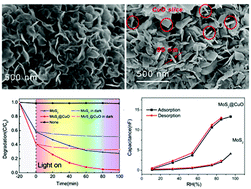
MoS2@CuO heterogeneous structure nanoflowers were synthesized through a two-step hydrothermal method for the first time. The valence band offset (VBO) and conduction band offset (CBO) of the MoS2@CuO heterojunction, and the bases for the design of the heterogeneous structure were determined by X-ray photoemission spectroscopy (XPS). For the increased specific surface area and the formation of staggered type-II band alignment of the composite structure, a significantly enhanced photocatalytic ability of the MoS2@CuO heterojunction was obtained by studying the photodegradation of methylene blue (MB). After irradiation for 100 min, the residual MB in solution was about 27.5% for pristine MoS2 nanoflowers while it was 4.3% for MoS2@CuO hetero-nanoflowers, respectively. The humidity sensing properties of the two nanostructures were also studied for comparison. The results showed that better response/recover times were obtained. In order to give a theoretical explanation for this phenomenon, we performed first-principles calculation to analyse the corresponding humidity sensing mechanisms of MoS2 and MoS2@CuO in detail. The calculated results showed that water molecules could bind stronger to the CuO surface compared to MoS2, which is in line with the experimental observations.
 Please wait while we load your content...


