Gong Zhang, Siqi Zheng, Haiping Liu and Peng R. Chen
Chem. Soc. Rev., 2015,44, 3405-3417
DOI:
10.1039/C4CS00393D,
Tutorial Review


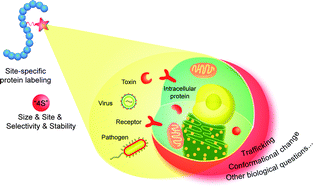
Coupling genetically encoded peptide tags or unnatural amino acids (UAAs) with bioorthogonal reactions allows for precise control over the protein-labeling sites as well as the wide choice of labeling dyes. However, the value of these site-specific protein labeling strategies in a real biology setting, particularly their advantages over conventional labeling methods including fluorescent proteins (FPs), remains to be fully demonstrated. In this tutorial review, we first introduce various strategies for site-specific protein labeling that utilize artificial peptide sequences or genetically encoded UAAs as the labeling handle. Emphasis will be placed on introducing the advantages of protein site-specific labeling techniques as well as their applications in solving biological problems, particularly as to why a site-specific protein labeling approach is needed. Finally, beyond the widely used single site-specific labeling methods, the recently emerged dual site-specific protein labeling strategies will be introduced together with their fast-growing potential in illustrating biological processes.