


 PLATFORM UPDATE:

Tetrahedral node diamondyne frameworks for CO2 adsorption and separation†
Abstract
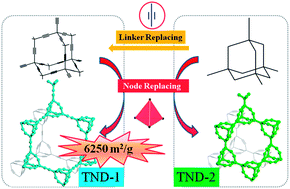
The recently reported diamondyne is a fascinating new carbon allotrope with multifunctional applications (J. Mater. Chem. A, 2013, 1, 3851; ibid 2013, 1, 9433). Here we theoretically predict two new tetrahedral node diamondyne (TND) frameworks by replacing the carbon nodes of diamondyne and diamond with the acetylenic linkage (C–C![[triple bond, length as m-dash]](https://www.rsc.org/images/entities/char_e002.gif) C–C)-formed tetrahedron node. The two resulting theoretical materials (marked as TND-1 and TND-2) exhibit extremely high specific surface areas (SSA) of 6250 and 2992 m2 g−1, respectively. Interestingly, the SSA of TND-1 is calculated to be the highest among all porous carbon materials. By further studying the CO2 capture performance of TND-1 and TND-2, it is found that the CO2 uptake of TND-1 reaches 2461 mg g−1 at 298 K and 50 bar, which outperforms all MOFs, COFs and ZIFs, while the selectivity of TND-2 for CO2/H2 reaches 104 at 35 bar, which is superior to most of the porous materials. In short, the hypothetical TND frameworks are promising candidates for CO2 capture in practical industry.
C–C)-formed tetrahedron node. The two resulting theoretical materials (marked as TND-1 and TND-2) exhibit extremely high specific surface areas (SSA) of 6250 and 2992 m2 g−1, respectively. Interestingly, the SSA of TND-1 is calculated to be the highest among all porous carbon materials. By further studying the CO2 capture performance of TND-1 and TND-2, it is found that the CO2 uptake of TND-1 reaches 2461 mg g−1 at 298 K and 50 bar, which outperforms all MOFs, COFs and ZIFs, while the selectivity of TND-2 for CO2/H2 reaches 104 at 35 bar, which is superior to most of the porous materials. In short, the hypothetical TND frameworks are promising candidates for CO2 capture in practical industry.
 Please wait while we load your content...


