


 PLATFORM UPDATE:

Microwave assisted synthesis and characterization of silicon and phosphorous co-doped carbon as an electrocatalyst for oxygen reduction reaction
Abstract
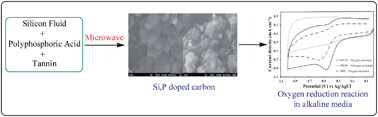
Doped carbon materials have gained a lot of attention recently due to their wide array of applications. These doped carbon materials have a tremendous potential to replace expensive metal based electrocatalysts in fuel cells. A recently established microwave assisted technique, which does not make use of any inert or reducing gases, has been used to synthesize novel silicon (Si), phosphorous (P) co-doped carbon (SiPDC), as yet not reported in the literature. The method is simple, rapid and economical. Tannin, a renewable resource material is chosen as the carbon source, polyphosphoric acid is utilized as the dehydrating agent/P source and silicone oil is chosen as the Si source. Brunauer–Emmett–Teller analysis reveals the surface area of SiPDC to be 641.51 m2 g−1 and X-ray photoelectron spectroscopy confirms the doping of Si and P at 8.80% and 4.20% respectively. The doped carbon material is utilized for oxygen reduction reaction (ORR) in 0.1 M KOH. The mechanism of ORR is found to be a four electron reduction process based on rotating disk electrode studies. Electrochemical stability studies are performed to evaluate the effectiveness of the catalyst for practical applications.
 Please wait while we load your content...


