


 PLATFORM UPDATE:


Porous SnO2–Fe2O3 nanocubes with improved electrochemical performance for lithium ion batteries†
Abstract
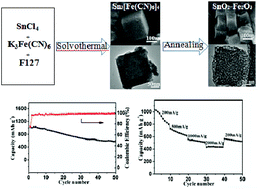
Mixed oxide SnO2–Fe2O3 porous nanocubes were prepared by simply annealing the precursor of Sn3[Fe(CN)6]4 nanocubes, which were obtained through a facile solvothermal method. Calcination of the precursor at 350 °C produced uniform SnO2–Fe2O3 nanocubes without obvious morphological deformation, but with lots of open void space in the nanocubes. The Brunauer–Emmett–Teller N2 adsorption–desorption analysis shows that the as-synthesized SnO2–Fe2O3 has a specific surface area of 170.2 m2 g−1 with a pore size of around 5 nm. The porous SnO2–Fe2O3 nanocubes as anode materials for the lithium-ion battery show a high initial capacity of 1020.2 mA h g−1 at a current density of 200 mA g−1 and maintain at 567.5 mA h g−1 at the 50th cycle, which is distinctly higher than those reported for SnO2-based materials. The enhanced performance towards lithium storage can be ascribed to the high specific area, an appropriate pore size and the synergistic effect of SnO2 and Fe2O3.
 Please wait while we load your content...


