


 PLATFORM UPDATE:

Synthesis and characterization of oxygen-functionalised-NHC silver(i) complexes and NHC transmetallation to nickel(ii)†
Abstract
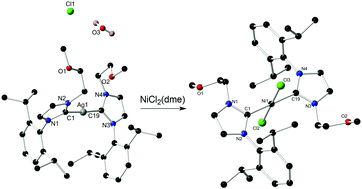
The new alcohol- and ether-functionalised-NHC silver(I) complexes bis(1-(2,6-diisopropylphenyl)-3-(2-hydroxyethyl)-1H-imidazol-2(3H)-ylidene)silver(I) chloride, [Ag{ImDiPP(C2OH)}2]Cl (4), bis(1-(2-hydroxyethyl)-3-mesityl-1H-imidazol-2(3H)-ylidene)silver(I) chloride, [Ag{ImMes(C2OH)}2]Cl (5), bis(1-(2-hydroxyethyl)-3-methyl-1H-imidazol-2(3H)-ylidene)silver(I) chloride, [Ag{ImMe(C2OH)}2]Cl (6), bis(1-(2,6-diisopropylphenyl)-3-(2-hydroxyethyl)-1H-imidazol-2(3H)-ylidene)silver(I) tetrafluoroborate, [Ag{ImDiPP(C2OH)}2]BF4 (9), and bis(1-(2,6-diisopropylphenyl)-3-(2-methoxyethyl)-1H-imidazol-2(3H)-ylidene)silver(I) chloride, [Ag{ImDiPP(C2OMe)}2]Cl (13), were synthesized and fully characterized by NMR spectroscopy and single crystal X-ray diffraction. For some complexes, an uncommon heteronuclear coupling 4J(107/109Ag–H) was unveiled. Their ability to transfer the NHC ligand to Ni(II) was assessed in the presence of different nickel(II) sources; the bis-NHC Ni(II) complex bis(1-(2,6-diisopropylphenyl)-3-(2-methoxyethyl)-1H-imidazol-2(3H)-ylidene)nickel(II) chloride, [NiCl2{ImDiPP(C2OMe)}2] (15), was obtained from 13 and shown by X-ray diffraction study to have a trans-arrangement of the two NHC ligands. However, in contrast to other Ag(I) NHC complexes the transmetallation reaction failed with the hydroxyl-functionalised silver complexes, possibly due to the acidity of the alcohol OH function, leading overall to reprotonation of the CNHC and isolation of the corresponding imidazolium salts.
 Please wait while we load your content...


