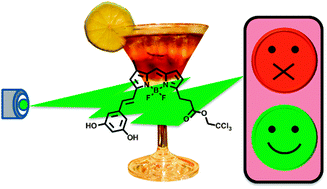
Development of a fluorescent sensor for an illicit date rape drug – GBL†
Abstract
The first fluorescent sensor for an illicit date rape
We are excited to let you know that our journals content will be migrating to the Silverchair platform on the 30th June 2026.
All of our content will still be hosted at pubs.rsc.org and the new platform will provide a more intuitive reading and navigation experience, along with improved discovery and indexing of your work.
Please be aware that the site will be temporarily unavailable on the 30th June to support the migration to the new platform. If you are unable to access the platform on the day, please try again later.
We look forward to seeing you on the new platform!
* Corresponding authors
a
Department of Chemistry and MedChem Program, Life Sciences Institute, National University of Singapore, 3 Science Drive 3, Singapore 117543
E-mail:
chmcyt@nus.edu.sg
b Laboratory of Bioimaging Probe Development, Singapore Bioimaging Consortium (SBIC), Agency for Science, Technology and Research (A*STAR), Biopolis, 11 Biopolis Way, #02-02 Helios, Singapore 138667
The first fluorescent sensor for an illicit date rape
Please wait while we load your content...
Something went wrong. Try again?
D. Zhai, B. K. Agrawalla, P. S. F. Eng, S. Lee, W. Xu and Y. Chang, Chem. Commun., 2013, 49, 6170 DOI: 10.1039/C3CC43153C
This article is licensed under a Creative Commons Attribution 3.0 Unported Licence. You can use material from this article in other publications without requesting further permissions from the RSC, provided that the correct acknowledgement is given.
Read more about how to correctly acknowledge RSC content.
Fetching data from CrossRef.
This may take some time to load.
Loading related content