It is still unclear how light and gibberellins are integrated to regulate petal
size. Here, we report that light improves both the length and the width of the ray floret
petals in G. hybrid, but GA3 promotes only the petal length. It is also
revealed that the control of the petal size by light and GA3 depends on
modulating the cell size, which is governed by the behavior of cortical microtubule.
Light
and gibberellins are important regulators of plant organ
growth. However, little is known about their roles in petal size determination. Here, we
report how light and gibberellic acid (GA3) signals are integrated to regulate
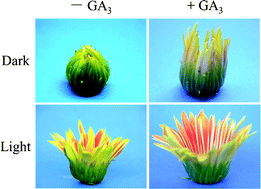
the ray floret (Rf) size in Gerbera hybrida. The inflorescences of G.
hybrida at stages 1.5 were cultivated in vitro for 9 d followed by the
determination of the Rf petal size. Results demonstrated that the light signal
significantly enhanced both the length and the width of Rf petals, but GA3
promoted only the petal length. Moreover, GA3 displayed a synergistic positive
effect on the length but an antagonistic effect on the width with the light signal.
Measurements of the petal cells revealed that the cell size, not the cell number,
exhibited a dominant contribution to the petal size in response to light and
GA3 signals. Furthermore, light and GA3 signals not only induced
an obvious reorientation of cortical microtubules (MTs) into transverse arrays but also
promoted the recovery of the MT lengths in petal cells following oryzalin (an MT depolymerizing agent) treatment. Importantly, disruption of
the MT lengths and arrays by oryzalin could inhibit
the cell expansion and the petal enlargement induced by light or/and GA3
signals. Taken together, it is concluded that the control of the petal size by light and
GA3 signals mainly depends on modulating the cell size and, moreover, the
organization of the cortical MTs plays a crucial role in the control of the cell size and
hence the Rf petal growth.


 PLATFORM UPDATE:

 Please wait while we load your content...
