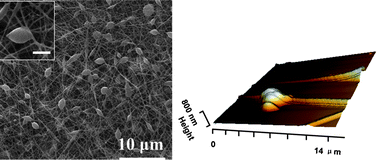
The influence of nanoscale surface topographical features on cell functions has attracted more and more attention in the last few years. Herein, the surface nanoroughness on a nanofiber membrane was engineered with an electrospinning approach by simply adjusting the concentration of the polymer solution. The surface topographical features were characterized with scanning electron microscopy (SEM) and atomic force microscopy (AFM). The impact of different surface nanoroughness on cellular behavior was further investigated from cell adhesion, spreading, proliferation and differentiation, through co-culturing with rat bone marrow mesenchymal stem cells (rBMSCs). Investigation of the effect of surface nanoroughness on subcutaneous bone formation in vivo was also performed, and a histological section was dyed with H&E and Masson's trichrome staining. The distinctive acquired result shows that the existence of beads on electrospun nanofibers does not bring any negative effect on cell growth, and moreover the moderate surface nanoroughness can modulate and facilitate cellular behaviors compared with the smooth surface. Therefore, we think that the electrospun nanofibers with suitable nanoroughness can have great potential for biomedical applications as a tissue engineering scaffold.
You have access to this article
 Please wait while we load your content...
Something went wrong. Try again?
Please wait while we load your content...
Something went wrong. Try again?


 PLATFORM UPDATE: