


 PLATFORM UPDATE:

Epitaxial electrodeposition of chiral CuO films from copper(ii) complexes of malic acid on Cu(111) and Cu(110) single crystals†
Abstract
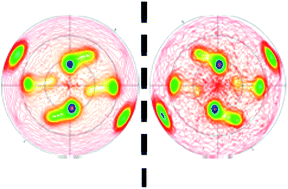
Chiral films of CuO were anodically electrodeposited onto Cu(111) and Cu(110) single crystals from alkaline solutions of Cu(II) complexed with the malate ion. The chirality of the film was directed by the chiral solution precursor. ![[1 with combining macron]](https://www.rsc.org/images/entities/char_0031_0304.gif) 11) and (311) orientations and the films grown from D-malate had (1) and (
11) and (311) orientations and the films grown from D-malate had (1) and (![[3 with combining macron]](https://www.rsc.org/images/entities/char_0033_0304.gif) ) orientations. CuO films grown on Cu(110) from L-malate had (110) and (31) orientations, whereas the films grown from D-malate deposition bath had (0) and (1) orientations. The CuO films grown from a racemic malate bath showed only the (11) and (1) orientations on Cu(111) and (110) and (0) orientations on Cu(110). Single crystals of L-, D- and DL-bis(malato)copper(II) dihydrate complexes were synthesized and the structures were determined with
) orientations. CuO films grown on Cu(110) from L-malate had (110) and (31) orientations, whereas the films grown from D-malate deposition bath had (0) and (1) orientations. The CuO films grown from a racemic malate bath showed only the (11) and (1) orientations on Cu(111) and (110) and (0) orientations on Cu(110). Single crystals of L-, D- and DL-bis(malato)copper(II) dihydrate complexes were synthesized and the structures were determined with
 Please wait while we load your content...
