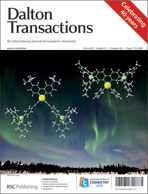
The potential energy surfaces for the chemical reactions of group 14 carbenes have been studied using density functional theory (B3LYP/LANL2DZ). Five saturated five-membered-ring N-heterocyclic carbene Dipp![[upper bond 1 start]](https://www.rsc.org/images/entities/char_e010.gif) N(CH2)2N(Dipp)E
N(CH2)2N(Dipp)E![[upper bond 1 end]](https://www.rsc.org/images/entities/char_e011.gif) : (five-ring-E:) species, where E = C, Si, Ge, Sn and Pb, have been chosen as model reactants in this work. Also, four kinds of chemical reactions; addition of water, methane insertion, alkene cycloaddition and dimerization, have been used to study the chemical reactivities of these group 14 carbenes. The present theoretical investigations suggest that the relative carbenic reactivity decreases in the order: C > Si > Ge > Sn > Pb. That is, the heavier the group 14 atom (E), the more stable is the carbene towards chemical reactions. This may be the reason that there have been many instances reported of the synthesis and characterization of stable group 14 five-membered-ring N-heterocyclic carbene species with various alkyl protecting substituents at room temperature. Furthermore, the singlet–triplet energy splitting of the five-ring-E:, as described in the configuration mixing model attributed to the work of Pross and Shaik, can be used as a diagnostic tool to predict their reactivities. The results obtained allow a number of predictions to be made.
: (five-ring-E:) species, where E = C, Si, Ge, Sn and Pb, have been chosen as model reactants in this work. Also, four kinds of chemical reactions; addition of water, methane insertion, alkene cycloaddition and dimerization, have been used to study the chemical reactivities of these group 14 carbenes. The present theoretical investigations suggest that the relative carbenic reactivity decreases in the order: C > Si > Ge > Sn > Pb. That is, the heavier the group 14 atom (E), the more stable is the carbene towards chemical reactions. This may be the reason that there have been many instances reported of the synthesis and characterization of stable group 14 five-membered-ring N-heterocyclic carbene species with various alkyl protecting substituents at room temperature. Furthermore, the singlet–triplet energy splitting of the five-ring-E:, as described in the configuration mixing model attributed to the work of Pross and Shaik, can be used as a diagnostic tool to predict their reactivities. The results obtained allow a number of predictions to be made.

You have access to this article
 Please wait while we load your content...
Something went wrong. Try again?
Please wait while we load your content...
Something went wrong. Try again?


 PLATFORM UPDATE: