


 PLATFORM UPDATE:

Chemistry of phosphine–borane adducts at platinum centers: dehydrocoupling reactivity of Pt(ii) dihydrides with P–H bonds
Abstract
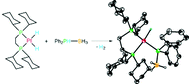
The reaction of the Pt(II) dihydride complex cis-[PtH2(dcype)] (dcype = 1,2-bis(dicyclohexylphosphino)ethane) with the primary or secondary phosphine–borane adducts PhRPH·BH3 (R = H, Ph) was found to exclusively afford the mono-substituted complexes cis-[PtH(PPhR·BH3)(dcype)] (1: R = H; 2: R = Ph) via a dehydrocoupling reaction between Pt–H and P–H bonds. Similar reactivity was observed between the uncoordinated phosphines PhRPH (R = H, Ph) and cis-[PtH2(dcype)], which gave cis-[PtH(PPhR)(dcype)] (4: R = H; 5: R = Ph). The complexes were characterized by 1H, 11B, 13C and 31P NMR spectroscopy, IR, MS and, in the case of 2, X-ray crystallography that confirmed the cis geometries. The di-substituted complex cis-[Pt(PhPH·BH3)2(dcype)] (3) was prepared from the reaction of cis-[PtCl2(dcype)] with two equivalents of Li[PPhH·BH3]. This suggested that steric reasons alone cannot be used to explain the lack of reactivity with respect to a second dehydrocoupling reaction involving the remaining Pt–H bond in complexes 1, 2, 4 and 5.
 Please wait while we load your content...


