


 PLATFORM UPDATE:


Bacteriophytochrome and regulation of the synthesis of the photosynthetic apparatus in Rhodopseudomonas palustris: pitfalls of using laboratory strains
Abstract
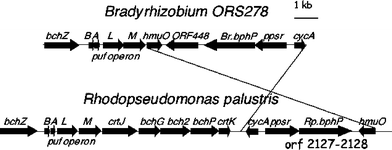
The synthesis of the photosynthetic apparatus of different strains of Rhodopseudomonas palustris has been studied as a function of the oxygen concentration and far-red light. For strain CEA001, only a small amount of photosynthetic apparatus is synthesized in the dark for oxygen concentration higher than 8% whereas synthesis is strongly enhanced by far-red light illumination. This enhancement is due to the action of a bacteriophytochrome (ORF2127/ORF2128), which antagonizes the repressor PpsR. On the contrary, a large fraction of photosystem is synthesized in the dark and far-red illumination induces no enhancement in strain CGA009. This difference in phenotype of strain CGA009 is explained by a single point-mutation R428C in the helix–turn–helix DNA binding motif of PpsR, rendering it inactive. In addition, a frame-shift mutation had occurred in the gene encoding bacteriophytochrome (ORF2127/ORF2128), conducting to a truncated inactive sensor. We propose that these mutations occurred in culture. Bacteria have developed a sophisticated regulatory process to synthesize their photosynthetic apparatus when light is available. This process is a critical advantage for the bacteria under natural conditions since they optimize their development depending on the available energy resources. On the contrary, under laboratory growth conditions where there is no substrate limitation, there is no crucial need for such a regulation and deleterious mutations affecting this process are of no importance.
- This article is part of the themed collection: Biological photosensors
 Please wait while we load your content...
