


 PLATFORM UPDATE:


Organisation and reactivity of silicon-based hybrid materials with various cross-linking levels
Abstract
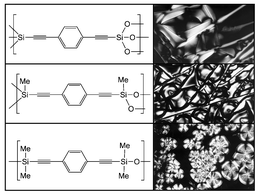
Nanostructured silicon-based hybrid materials were prepared by sol-gel hydrolysis/polycondensation of (MeO)3−nSiMen–C![[triple bond, length half m-dash]](https://www.rsc.org/images/entities/char_e007.gif) C–C6H4–CC–SiMen(OMe)3−n
(n = 0, 1, 2) precursors. Their organisation was evaluated by birefringence measurements (microscopy under polarised light) and evidences the possibility of self-association of the macromolecular units in the sol step and reorientation processes in the ageing step. In contrast to the texture (porosimetry with N2), the cross-linking level of the Si–O–Si network of the solids (29Si CPMAS spectroscopy) appears to be determinant for the anitropic organisation. For n = 2 the corresponding polymer –(–O–SiMe2–CC–C6H4–CC–SiMe2–)–
is crystallised and demonstrates the strong ability of the organic units to self-associate. This is also suggested by partial polymerisation of the acetylenic moieties of the organic units in the solid state up to 350 °C (DSC, IRTF).
C–C6H4–CC–SiMen(OMe)3−n
(n = 0, 1, 2) precursors. Their organisation was evaluated by birefringence measurements (microscopy under polarised light) and evidences the possibility of self-association of the macromolecular units in the sol step and reorientation processes in the ageing step. In contrast to the texture (porosimetry with N2), the cross-linking level of the Si–O–Si network of the solids (29Si CPMAS spectroscopy) appears to be determinant for the anitropic organisation. For n = 2 the corresponding polymer –(–O–SiMe2–CC–C6H4–CC–SiMe2–)–
is crystallised and demonstrates the strong ability of the organic units to self-associate. This is also suggested by partial polymerisation of the acetylenic moieties of the organic units in the solid state up to 350 °C (DSC, IRTF).
 Please wait while we load your content...


