


 PLATFORM UPDATE:


Coordination behaviour of (diaryl disulfide)-bridged dinuclear thiairidaindan cores: ligand substitution by isocyanides, CO, hydrazines and hydroxylamine, and related reactions†
Abstract
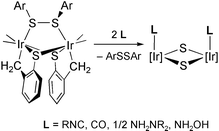
The diaryl ![[upper bond 1 start]](https://www.rsc.org/images/entities/char_e010.gif) r(μ-SC6H4 −
nMenC
r(μ-SC6H4 −
nMenC![[upper bond 1 end]](https://www.rsc.org/images/entities/char_e011.gif) H2)Cl(PPh3)}2(μ-ArSSAr)] [1a, n
= 1, Ar = C6H3Me2-2,6 (Xy); 1b, n
= 2, Ar = C6H2Me3-2,4,6 (Mes)] is readily substituted by r(μ-SC6H4 −
nMenCH2)Cl(PPh3)(L)]2 (2a, n
= 1, L = XyNC; 2b, n
= 2, L =
XyNC; 3a, n
= 1, L = ButNC; 3b, n
= 2, L = ButNC; 4a, n
= 1, L = CO; 4b, n
= 2, L = CO; 7a, n
= 1, L = NH2OH; 7b, n
= 2, L = NH2OH) and the bridging r(μ-SC6H4 −
nMenCH2)Cl(PPh3)}2(μ-NH2NR2)] (5a, n
= 1, R = H; 5b, n
= 2, R = H; 6, n
=
1, R = Me), respectively. On the other hand, the reaction of 1b with MeLi resulted in reductive cleavage of the r(μ-SC6H2Me2CH2)(SMes)(PPh3)]2 (8), which was further converted into the bis(carbonyl) complex [Ir(μ-SC6H2Me2CH2)(SMes)(PPh3)(CO)]2 (9) upon addition of CO. Treatment of 2b with AgPF6 led to the formation of the difluorophosphato-bridged complex [{Ir(μ-SC6H2Me2CH2)(PPh3)(XyNC)}2(μ-PF2O2)][PF6] (10).
The structures of the thiairidaindan complexes 2b, 4a, 5a, 7a and 8–10 have been determined by
H2)Cl(PPh3)}2(μ-ArSSAr)] [1a, n
= 1, Ar = C6H3Me2-2,6 (Xy); 1b, n
= 2, Ar = C6H2Me3-2,4,6 (Mes)] is readily substituted by r(μ-SC6H4 −
nMenCH2)Cl(PPh3)(L)]2 (2a, n
= 1, L = XyNC; 2b, n
= 2, L =
XyNC; 3a, n
= 1, L = ButNC; 3b, n
= 2, L = ButNC; 4a, n
= 1, L = CO; 4b, n
= 2, L = CO; 7a, n
= 1, L = NH2OH; 7b, n
= 2, L = NH2OH) and the bridging r(μ-SC6H4 −
nMenCH2)Cl(PPh3)}2(μ-NH2NR2)] (5a, n
= 1, R = H; 5b, n
= 2, R = H; 6, n
=
1, R = Me), respectively. On the other hand, the reaction of 1b with MeLi resulted in reductive cleavage of the r(μ-SC6H2Me2CH2)(SMes)(PPh3)]2 (8), which was further converted into the bis(carbonyl) complex [Ir(μ-SC6H2Me2CH2)(SMes)(PPh3)(CO)]2 (9) upon addition of CO. Treatment of 2b with AgPF6 led to the formation of the difluorophosphato-bridged complex [{Ir(μ-SC6H2Me2CH2)(PPh3)(XyNC)}2(μ-PF2O2)][PF6] (10).
The structures of the thiairidaindan complexes 2b, 4a, 5a, 7a and 8–10 have been determined by
 Please wait while we load your content...
