


 PLATFORM UPDATE:

Alkyne–phosphinoalkyne coupling reactions on mixed-metal tungsten–cobalt centres; P–C(alkyne) bond cleavage versus P–C(alkyne) bond preservation
Abstract
Reactions of the alkyne-bridged tungsten–cobalt complexes [(η5-C5H5)(OC)2W(μ-R1CCR2)Co(CO)3] (R1 = R2 = CO2Me 1a; R1 = H, R2 = But1b) with Ph2PC![[triple bond, length as m-dash]](https://www.rsc.org/images/entities/char_e002.gif) CPh in refluxing CPh)] 2, the result of substitution of a cobalt CPh, [(η5-C5H5)(OC)2W{μ-PhCCC(CO2Me)
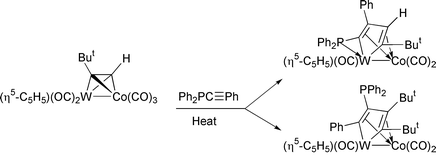
CPh in refluxing CPh)] 2, the result of substitution of a cobalt CPh, [(η5-C5H5)(OC)2W{μ-PhCCC(CO2Me)![[double bond, length as m-dash]](https://www.rsc.org/images/entities/char_e001.gif) C(CO2Me)PPh2}Co(CO)2] 3 and [(η5-C5H5)(OC)W{μ-C(CO2Me)C(CCPh)C(OMe)O}(μ-PPh2)Co(CO)2] 4, in which phosphorus–carbon(alkyne) bond cleavage of the phosphinoalkyne has ocurred along with phosphorus–carbon bond formation (3) and/or carbon–carbon bond formation (3 and 4). In contrast, reaction of 1b with Ph2PCCPh affords two products, [(η5-C5H5)(OC)W{μ-CButCHCPhC(PPh2)}Co(CO)2] 5 and [(η5-C5H5)(OC)2W{μ-CButCHC(PPh2)CPh}Co(CO)2] 6, in which the bridging CβPh at either its β- or α-carbon atoms, respectively. However, on reaction of 1b with the CBut, regiospecific coupling and CHCButC(PPh2O)}Co(CO)2] 8, as the sole product. The reactivity of 6 towards diiron nonacarbonyl has been explored and found to afford the trimetallic complex [(η5-C5H5)(OC)2W{μ-CButCHC(PPh2Fe(CO)4)CPh}Co(CO)2] 7 in good yield.
C(CO2Me)PPh2}Co(CO)2] 3 and [(η5-C5H5)(OC)W{μ-C(CO2Me)C(CCPh)C(OMe)O}(μ-PPh2)Co(CO)2] 4, in which phosphorus–carbon(alkyne) bond cleavage of the phosphinoalkyne has ocurred along with phosphorus–carbon bond formation (3) and/or carbon–carbon bond formation (3 and 4). In contrast, reaction of 1b with Ph2PCCPh affords two products, [(η5-C5H5)(OC)W{μ-CButCHCPhC(PPh2)}Co(CO)2] 5 and [(η5-C5H5)(OC)2W{μ-CButCHC(PPh2)CPh}Co(CO)2] 6, in which the bridging CβPh at either its β- or α-carbon atoms, respectively. However, on reaction of 1b with the CBut, regiospecific coupling and CHCButC(PPh2O)}Co(CO)2] 8, as the sole product. The reactivity of 6 towards diiron nonacarbonyl has been explored and found to afford the trimetallic complex [(η5-C5H5)(OC)2W{μ-CButCHC(PPh2Fe(CO)4)CPh}Co(CO)2] 7 in good yield.
 Please wait while we load your content...
