Chen Xi Li, Xiang Li, Xin Yi Chen, Chen Chen, Lei Zhao and Nan Ma
J. Mater. Chem. C, 2023,11, 12561-12569
DOI:
10.1039/D3TC02590J,
Paper


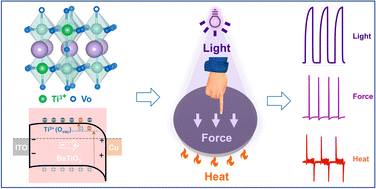
Ferroelectric materials possess piezoelectric, pyroelectric, and photovoltaic properties simultaneously, making them ideal for use in multi-sensor applications. However, it has been challenging to balance the photovoltaic properties with piezoelectric/pyroelectric properties within a single material due to the narrow bandgap and ferroelectricity being incompatible. In this study, Ti3+ self-doping in BaTiO3 (BTO) ceramic is proposed as a solution to reduce the bandgap while maintaining the ferroelectric properties. The influence of Ti3+ self-doping on the piezoelectric, pyroelectric, and photovoltaic properties was systematically investigated. It was found that Ti3+ self-doping not only reduces the bandgap but also enables good ferroelectric properties in BTO. This results in a piezoelectric coefficient of 75 pC/N, a pyroelectric coefficient of 59 μC m−2 K−1, and a significant increase in photocurrent by 672.7% under 405 nm illumination. Therefore, Ti3+ self-doped BTO exhibits great potential for multisensory applications for detecting contact force, temperature, and light. These findings provide a new approach to expanding the application of multifunctional ferroelectric materials.