Reply to the ‘Comment on “Mapping photoisomerization dynamics on a three-state model potential energy surface in bacteriorhodopsin using femtosecond stimulated Raman spectroscopy”’ by I. Schapiro, M. Olivucci, K. Heyne and S. Haacke, Chem. Sci., 2025, 16, DOI: 10.1039/D5SC05038C

Abstract

We appreciate the insightful comments by Dr Schapiro et al. on our recent article (Chem. Sci., 2025, 16, 3713). Their comment raises valuable points concerning the excitation regime employed in our femtosecond stimulated Raman spectroscopy (FSRS) experiments, the interpretation of the newly observed 1820 cm−1 vibronic band, and the electronic-state assignments of the I and J intermediates in the photoisomerization of bacteriorhodopsin (bR). In this reply, we provide detailed clarifications, supplementary analyses, and additional experimental evidence to address these concerns. These results reinforce the validity of our FSRS interpretation of the AT-PSBR photoisomerization dynamics and clarify the photochemical roles of the I and J intermediates in the retinal protein photocycle.
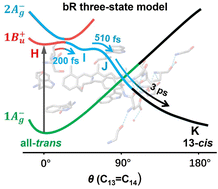
Graphical abstract: Reply to the ‘Comment on “Mapping photoisomerization dynamics on a three-state model potential energy surface in bacteriorhodopsin using femtosecond stimulated Raman spectroscopy”’ by I. Schapiro, M. Olivucci, K. Heyne and S. Haacke, Chem. Sci., 2025, 16, DOI: 10.1039/D5SC05038C

Associated articles

Transparent peer review

To support increased transparency, we offer authors the option to publish the peer review history alongside their article.

View this article’s peer review history

Article information

Article type
Comment
Submitted
20 Oct 2025
Accepted
16 Nov 2025
First published
19 Dec 2025
This article is Open Access

All publication charges for this article have been paid for by the Royal Society of Chemistry
Creative Commons BY-NC license

Chem. Sci., 2026, Advance Article

Reply to the ‘Comment on “Mapping photoisomerization dynamics on a three-state model potential energy surface in bacteriorhodopsin using femtosecond stimulated Raman spectroscopy”’ by I. Schapiro, M. Olivucci, K. Heyne and S. Haacke, Chem. Sci., 2025, 16, DOI: 10.1039/D5SC05038C

Z. Wang, B. Liu, H. Li and W. Liu, Chem. Sci., 2026, Advance Article , DOI: 10.1039/D5SC08089D

This article is licensed under a Creative Commons Attribution-NonCommercial 3.0 Unported Licence. You can use material from this article in other publications, without requesting further permission from the RSC, provided that the correct acknowledgement is given and it is not used for commercial purposes.

To request permission to reproduce material from this article in a commercial publication, please go to the Copyright Clearance Center request page.

If you are an author contributing to an RSC publication, you do not need to request permission provided correct acknowledgement is given.

If you are the author of this article, you do not need to request permission to reproduce figures and diagrams provided correct acknowledgement is given. If you want to reproduce the whole article in a third-party commercial publication (excluding your thesis/dissertation for which permission is not required) please go to the Copyright Clearance Center request page.

Read more about how to correctly acknowledge RSC content.

Social activity

Spotlight

Advertisements