


 PLATFORM UPDATE:


Retracted Article: Photo-generated radical mediated molecular luminescence enhancement
 a
Xiang
Ma
*a
a
Xiang
Ma
*a
Abstract
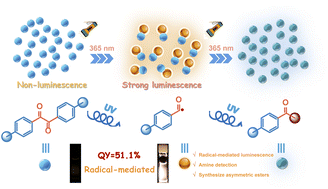
Achieving rapid modulation of molecular luminescence under external stimuli remains a significant challenge in organic luminescent materials. Herein, we present a radical-mediated approach to achieve dynamic fluorescence switching. A series of benzil derivatives (BS, BZ, BD, and BQ) exhibit rapid transitions from nearly non-luminescent states to highly fluorescent states under continuous ultraviolet (UV) irradiation in solution. Notably, the absolute photoluminescence quantum yield of BS solution increased 41-fold, from 1.26% to 51.09%, after 330 s of 365 nm UV exposure. Mechanistic investigations reveal that this unique luminescence enhancement originates from UV-induced generation of aromatic carbonyl radicals. In general, molecules in solution undergo photodegradation with increasing irradiation time, resulting in a decrease in luminescence intensity. In contrast, we report a molecule whose luminescence intensity increases with increasing irradiation time, which is very rare. This work not only advances the mechanistic understanding of stimuli-responsive luminescence but also opens a new avenue for designing smart organic materials with tailored optoelectronic functionalities.
 Please wait while we load your content...


