


 PLATFORM UPDATE:


Structure-based design, synthesis, and biological activity evaluation of chalcone-piperazine derivatives as dual AChE and MAO B inhibitors
 abc
Begüm Nurpelin
Sağlık Özkan,
bd
Derya
Osmaniye,
bd
Serkan
Levent,
de
Yusuf
Özkay
bd
and
Zafer Asım
Kaplancıklı
*bf
abc
Begüm Nurpelin
Sağlık Özkan,
bd
Derya
Osmaniye,
bd
Serkan
Levent,
de
Yusuf
Özkay
bd
and
Zafer Asım
Kaplancıklı
*bf
Abstract
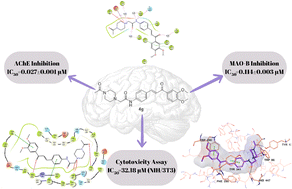
The development of pharmaceutical compounds for the treatment of Alzheimer's Disease (AD) and other neurodegenerative diseases is crucial, as the pathophysiology of AD remains incompletely understood and effective treatments are still lacking. In this study, a series of novel compounds based on Donepezil, incorporating piperazine and chalcone structures, were designed, synthesized, and characterized. The structures of the compounds were confirmed using IR, 1H-NMR, 13C-NMR, and HRMS techniques. Biological activities of the compounds were evaluated against cholinesterase enzymes and monoamine oxidase enzymes. The most potent derivative against acetylcholinesterase (AChE) was compound 4g, with an IC50 value of 0.027 ± 0.001 μM, and the most potent against monoamine oxidase B (MAO B) was also 4g, with an IC50 value of 0.114 ± 0.003 μM. In silico studies further elucidated the interaction of compound 4g with AChE. Molecular docking revealed key interactions between 4g and amino acids in the AChE active site. A 100 ns molecular dynamics simulation confirmed the stability of the 4g-AChE complex.
 Please wait while we load your content...


