


 PLATFORM UPDATE:


Electrochemical detection of chlorogenic acid in green coffee beans by a carbon paste electrode modified with MWCNTs and Cr-MOF

Abstract
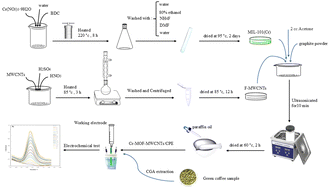
The purpose of this study is to address the need for rapid and selective detection of chlorogenic acid (CGA), a bioactive polyphenol with considerable medicinal importance. There are various techniques to determine the amount of CGA, but electrochemical methods are a cost-effective and efficient alternative. In this study, an efficient electrochemical sensor was prepared for the detection and measurement of CGA in green coffee samples. A composite of MIL-101(Cr) and MWCNTs was utilized to modify the carbon paste electrode (CPE). The metal–organic framework (MOF) was used due to its high surface area and known catalytic activity. The modified sensor showed improved electron-transfer and absorption capabilities, leading to a low detection limit and a wide linear range. The structure of the Cr-MOF and MWCNT compounds synthesized in this work was determined and analyzed using FT-IR, EDX, SEM, and XRD techniques. Electrochemical impedance spectroscopy (EIS) and cyclic voltammetry (CV) were also used to investigate the electrochemical efficiency of the modified electrode. Under optimal conditions, the differential pulse voltammetry (DPV) diagram showed that the relationship between the CGA concentration and current intensity is in two linear ranges, with a determination coefficient of 0.9855 in concentrations from 0 to 14.4 μM and a determination coefficient of 0.9962 in concentrations from 14 to 177.6 μM. The limit of detection (LOD) was 0.0198 μM. Finally, the modified sensor was validated using a standard UV-vis method.
 Please wait while we load your content...


