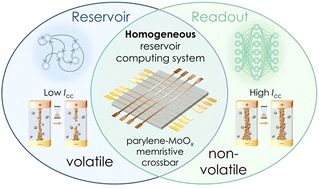
From the very beginning, the emulation of biological principles has been the primary avenue for the development of energy-efficient artificial intelligence systems. Reservoir computing, which has a solid biological basis, is particularly appealing due to its simplicity and efficiency. So-called memristors, resistive switching elements with complex dynamics, have proved beneficial for replicating both principal parts of a reservoir computing system. However, these parts require distinct behaviors found in differing memristive structures. The development of a homogeneous memristive reservoir computing system will significantly facilitate and reduce the fabrication process cost. The following work employs the co-existence of volatile and non-volatile regimes in parylene-MoOx crossbar memristors controlled by compliance current for this aim. The stable operation of the memristors under study is confirmed by low cycle-to-cycle and device-to-device variations of the switching voltages. For the transition between the volatile and non-volatile regimes, factors such as compliance current and reading voltage along with possible intrinsic origins are discussed. The results provide a foundation for the future hardware development of a homogeneous parylene-based reservoir computing system, considering high MNIST dataset classification accuracy (∼96%).