Subin Kaladi Chondath and Mini Mol Menamparambath
Faraday Discuss., 2023,247, 227-245
DOI:
10.1039/D3FD00077J,
Paper


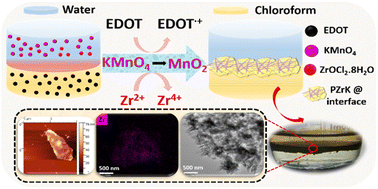
Owing to their magnificent chemical and physical properties, transition metal-based heterostructures are potential materials for applications ranging from point-of-care diagnostics to sustainable energy technologies. The cryptomelane-type octahedral molecular sieves (K-OMS-2) are extensively studied porous materials with a hollandite (2 × 2 tunnel of dimensions 4.6 × 4.6 Å2) structure susceptible to the isovalent substitution of metal cations at the framework of MnO6 octahedral chains. Here we report a facile in situ synthesis of framework-level zirconium (Zr)-doped K-OMS-2 nanoribbons in poly(3,4-ethylenedioxythiophene) (PEDOT) nanoflakes at a water/chloroform interface at ambient conditions. An oxidant system of KMnO4 and ZrOCl2·8H2O initiated the polymerisation at temperatures ranging from 5° to 50 °C. The lattice distortions arising from the framework-level substitution of Mn4+ by Zr4+ in the K-OMS-2 structure were evidenced with powder X-ray diffraction, Raman spectroscopy, X-ray photoelectron spectroscopy, and N2 adsorption–desorption studies. Transmission electron microscopic and mapping images confirmed that PEDOT/Zr-K-OMS-2 comprises a highly crystalline random network of two-dimensional PEDOT flakes and Zr-doped K-OMS-2 nanoribbons. In this regard, the proposed interfacial strategy affirms an in situ method for the morphological tuning of heterostructures on polymer supports at low temperatures.