


 PLATFORM UPDATE:

Novel degradable amphiphilic 4-arm star PLA-b-POEOA and PLGA-b-POEOA block copolymers: synthesis, characterization and self-assembly†
 a
Patrícia V.
Mendonça,
*a
Ana C.
Fonseca,
a
Arménio C.
Serra
a
and
Jorge F. J.
Coelho
*ab
a
Patrícia V.
Mendonça,
*a
Ana C.
Fonseca,
a
Arménio C.
Serra
a
and
Jorge F. J.
Coelho
*ab
Abstract
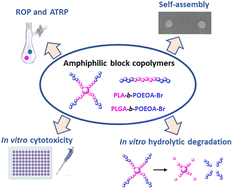
Well-defined amphiphilic biodegradable block copolymers (BCPs) are promising materials as drug/gene carriers because they can self-assemble in aqueous medium and form various nanostructures. In this work, conditions were developed for the controlled synthesis of amphiphilic 4-arm star-shaped and linear polylactide-b-poly((oligoethylene glycol) methyl ether acrylate) (PLA-b-POEOA) and poly(lactide-co-glycolide)-b-POEOA (PLGA-b-POEOA) BCPs by combining ring-opening polymerization (ROP) and initiators for continuous activator regeneration atom transfer radical polymerization (ICAR ATRP) using 6-fold lower metal catalyst concentration compared with other reports in the literature. A library of 4-arm star-shaped and linear BCPs with different degrees of polymerization of the monomers (LA, LGA and OEOA) was synthesized to investigate the influence of architecture, molecular weight and composition on the thermal properties, cytotoxicity and self-assembly behavior of the BCPs in aqueous solution. The amphiphilic star-shaped and linear BCPs were able to self-assemble into micelles in aqueous solution, which was confirmed by dynamic light scattering (DLS), scanning electron microscopy (SEM) and transmission electron microscopy (TEM). The ability of the BPCs to degrade under physiological conditions (pH = 7.4; 37 °C) was also confirmed by the decrease of the molecular weight of the polymers.
 Please wait while we load your content...


