


 PLATFORM UPDATE:

High-efficiency and high-fidelity ssDNA circularisation via the pairing of five 3′-terminal bases to assist LR-LAMP for the genotyping of single-nucleotide polymorphisms†
 *a
and
*a
and
Abstract
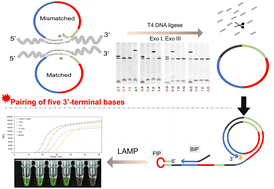
The poor fidelity of T4 DNA ligase has always limited the simple detection of single-nucleotide polymorphisms (SNPs) and is only applicable to some special SNP types. This study developed a highly sensitive and specific detection method for SNPs based on high-fidelity single-stranded circularisation. It used T4 DNA ligase and rolling circle amplification (RCA) plus loop-mediated isothermal amplification (LAMP). Surprisingly, the cyclisation stage's efficiency greatly improved. The ligation fidelity was almost perfect via the unique pairing pattern between a long-paired base at the 5′ terminus and only five bases at the 3′ terminus on linear single-stranded DNA (l-DNA). Subsequently, LR-LAMP was performed and combined with the circularisation step for the simple detection of SNPs. The results showed that even 100 aM targets could be detected correctly and that a mutation rate of 0.1% or even 0.01% could be analysed via naked-eye visualisation or fluorescence detection, respectively. In addition, genomic DNA samples were used to evaluate the method, which indicated that it could effectively distinguish the SNPs of RPA190-T1145A in Phytophthora infestans. This strategy may play an important role in both circularisation of single-stranded DNA and detecting arbitrary SNPs.
 Please wait while we load your content...


