


 PLATFORM UPDATE:


Subsystem density-functional theory for interacting open-shell systems: spin densities and magnetic exchange couplings†

Abstract
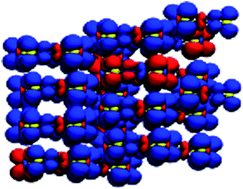
We investigate the possibility of describing interacting open-shell systems in high-spin and broken-symmetry (BS) states with subsystem density-functional theory (sDFT). This subsystem method typically starts from the electronic-structure results obtained for individual systems, for which the spin states can be individually defined. Through the confining effect of the embedding potential and/or the use of monomer basis sets, these individual spin states can be preserved in sDFT calculations. This offers the possibility of easy convergence to broken-symmetry states with arbitrary local spin patterns. We show that the resulting spin densities are in very good agreement with successfully converged broken-symmetry Kohn–Sham density-functional theory (KS-DFT) calculations. Yet sDFT can even cure those BS cases where KS-DFT suffers from convergence problems or convergence to undesired spin states. In contrast to KS-DFT, the sDFT-results only show a mild exchange–correlation functional dependence. We also show that magnetic coupling constants from sDFT are not satisfactory with standard approximations for the non-additive kinetic energy. When this component is evaluated “exactly”, i.e. based on potential reconstruction, however, the magnetic coupling constants derived from spin-state energy differences are greatly improved. Hence, the interacting radicals studied here represent cases where even (semi-)local approximations for the non-additive kinetic-energy potential work well, while the parent energy functionals do not yield satisfactory results for spin-state energy differences.
- This article is part of the themed collection: New horizons in density functional theory
 Please wait while we load your content...


