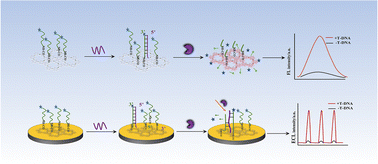
A fluorescence–electrochemiluminescence (FL–ECL) dual-mode sensor for apoE gene detection has been developed, leveraging the unique properties of ruthenium metal organic framework nanosheets (RuMOFNSs). The system utilizes the quenching effect of the Ru(bpy)32+ ECL signal by ferrocene, leading to the synthesis of a multi-electron electrical signal marker, bisferrocene. By immobilizing the P-DNA on RuMOFNSs, bisferrocene quenches both FL and ECL signals. The addition of T-DNA and the consequent formation of double-stranded DNA enable the ExoIII enzyme to excise the bisferrocene fragment, restoring the signals. The sensor demonstrates wide detection linear ranges (1 fM to 1 nM for FL and 0.01 fM to 10 pM for ECL) and remarkable sensitivity (0.048 fM for FL and 0.016 fM for ECL). The dual-mode design offers enhanced reliability through a self-correction feature, reducing false positives. Compared to single-mode sensors, the dual-mode sensor shows significant advantages. Real-world testing confirms the sensor's capacity for robust detection in actual samples, underscoring its promising application in early disease diagnosis. This innovative approach opens up avenues for multi-signal response sensors, offering significant potential for diagnostic technologies.