


Design of polymer–metal nanocatalyst interfaces for the electrochemical CO2 reduction reaction

Abstract
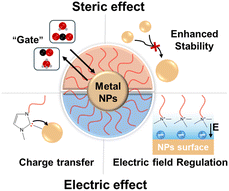
The electrochemical CO2 reduction reaction (eCO2RR) offers a promising strategy for carbon cycling by converting the greenhouse gas CO2 into value-added chemicals or fuels. Metal nanocatalysts are among the most desirable catalysts for facilitating CO2 activation. However, achieving high activity, selectivity, and long-term stability in these nanocatalysts remains challenging. Surface modification with synthetic polymer ligands offers an alternative route to resolve those challenges in the eCO2RR without redesigning nanocatalysts themselves. Most recent studies suggest that polymers not only enhance the structural stability of metal nanocatalysts but also provide an interfacial microenvironment that improves the eCO2RR through multiple mechanisms, including increasing the local CO2 concentration, stabilizing intermediates, and suppressing competitive proton reduction. In this review, we summarize the recent advances in the eCO2RR using metal nanocatalysts modified with polymer ligands, including nanocatalysts with hydrophobic, conductive, ionic and porous polymers. We discuss the mechanistic insights underlying polymer–catalyst interactions, with particular emphasis on how these interactions enhance catalytic performance. Finally, we conclude with key challenges and highlight future perspectives in this field.
- This article is part of the themed collection: Journal of Materials Chemistry A Recent Review Articles
 Please wait while we load your content...


