


Modulating halide leaving-group trends through recognition by bisboranes

Abstract
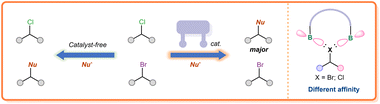
Modulating the intrinsic leaving-group tendency of halides remains a long-standing challenge in synthetic chemistry. Herein, we reported dynamic anion recognition and demonstrated its application in nucleophilic substitution reactions, enabling an apparent reversal of the halide leaving-group tendency sequence. A bidentate Lewis acid-based platform was developed to selectively bind halide ions, forming host–guest complexes that were characterized by NMR spectroscopy and X-ray crystallography. Competitive experiments with the host molecule have revealed tunable binding affinities for the halides based on the cavity size of the bisboron center. Moreover, anion exchange experiments have demonstrated that the dynamic binding of halides is primarily influenced by their nucleophilicity and ion radius. The recognition of organohalides by diborane hosts induced a reversal of the leaving ability of Br− and Cl− in diborane-catalyzed transformations, which deviated from the conventional sequence.
- This article is part of the themed collection: 2026 Chemical Science HOT Article Collection
 Please wait while we load your content...


