


Natural product inspired antibiotics approved for human use – 1943 to 2025
 a
and
Robert J.
Capon
*a
a
and
Robert J.
Capon
*a
Abstract
Covering literature to September 2025
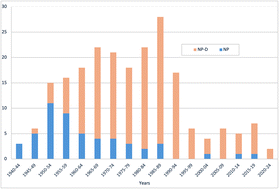
This review provides a comprehensive account of the 217 natural product inspired antibiotics that have been approved for human use from 1943 through to September 2025, inclusive of 52 (24%) that are natural products (NPs) and 165 (76%) that are semi-synthetic or synthetic derivatives of natural products (NP-Ds). These are organized into sixteen categories defined by shared structural motifs and, in many cases, common mechanisms of action. Each antibiotic is classified as either a NP or NP-D, annotated by a molecular structure that, where relevant, highlights the relationships between NPs and NP-Ds. Market details are also provided, including the company that brought each antibiotic to market, the year and country of first approval, the spectrum of usage across pathogen classes, routes of administration, current status, and selected commentary on mechanisms of action. The assembled dataset is further analysed through a series of charts that illustrate insightful trends that document the remarkable history and lasting impact of NP inspired antibiotics. The review concludes with observations on the historic impact and future prospects of natural products as a source of inspiration for the development of new generations of antibiotics.
 Please wait while we load your content...


