


Nanozymes for clean energy catalysis: unlocking potential, progress and perspectives

Abstract
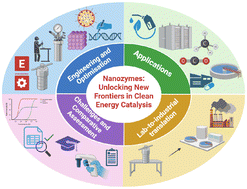
The growing need for sustainable and efficient energy conversion has driven the development of advanced catalytic materials. In this quest, nanozymes—nanomaterials that mimic the catalytic functions of natural enzymes emerge as promising candidates due to their tunable catalytic properties, high operational stability, and cost-effectiveness. This review presents recent advancements in the applications of nanozymes for clean energy technologies, focusing on their mechanistic roles and engineering strategies within the scope of key reactions, including hydrogen evolution reaction (HER), oxygen evolution and reduction reactions (OER, ORR), CO2 reduction, biofuel production, and methane-to-methanol conversion. The fundamental classes of nanozymes, their structure–activity relationships, and how their fine-tuned properties aid energy conversion in systems such as biofuel cells, electrolyzers, and fuel cells are also discussed. To underscore their practical advantages, nanozymes are benchmarked against conventional catalysts using key performance metrics such as turnover frequency, cost, and stability. Additionally, the review addresses challenges associated with limited selectivity, incomplete mechanistic understanding, and scalability while also highlighting emerging technologies such as nanostructuring, doping, hybridization, and 3D printing. By mapping recent advances and identifying critical research gaps, this review underscores the potential of established nanozymes and nanozyme-inspired catalytic systems as next-generation catalysts for clean energy applications and their role in advancing the transition toward a carbon-neutral and circular energy economy.
- This article is part of the themed collection: Recent Review Articles
 Please wait while we load your content...


