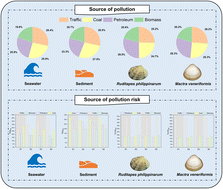
Industrialization and urbanization have led to increasing levels of PAH pollution in highly urbanized estuaries and their adjacent coastal areas globally. This study focused on the adjacent coastal area of the Yellow River Estuary (YRE) and collected surface seawater, surface sediment, and clams Ruditapes philippinarum and Mactra veneriformis at four sites (S1 to S4) in May, August, and October 2021 to analyze the source-specific ecological and health risks and bioeffects. The findings revealed that the main sources of PAHs were traffic emission (25.2% to 28.5%), petroleum sources (23.3% to 29.5%), coal combustion (24.7% to 27.5%), and biomass combustion (19.8% to 20.7%). Further, the PMF-RQ and PMF-ILCR analyses indicated that traffic emission was the primary contributor to ecological risks in seawater and health risks in both clam species, while coal combustion was the major contributor in sediment. Taken together, it is recommended to implement control strategies for PAH pollution following the priority order: traffic > coal > petroleum > biomass, to reduce the content and risk of PAHs in the YRE.