



Machine learning to design metal–organic frameworks: progress and challenges from a data efficiency perspective
 *ab
Tatiane Gercina
de Vilas,
a
Katherine
Ardila,
a
Fernando
Fajardo-Rojas
ab
and
Alexander J.
Pak
*abc
*ab
Tatiane Gercina
de Vilas,
a
Katherine
Ardila,
a
Fernando
Fajardo-Rojas
ab
and
Alexander J.
Pak
*abc
Abstract
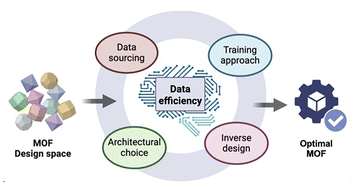
This review critically examines work at the intersection of machine learning (ML) and metal–organic frameworks (MOFs). The modular nature of MOFs enables immense design flexibility and applicability to a wide range of applications. However, the combinatorially large design space also stresses the resource-intensive nature of traditional high-throughput screening approaches. Due to the increasing availability of data in the form of experimental and hypothetical MOF structures and their properties, ML methods have emerged as a promising solution to accelerate MOF discovery, yet successful application of these methods will require strategies that maximize data and resource efficiency. This work surveys approaches to reduce data and resource burdens for MOF property prediction and design through feature engineering, model architecture choices, transfer learning, active learning, and generative models. We also discuss challenges related to data quality and scalability, as well as future opportunities for ML-empowered methods that, up to this point, have primarily focused on MOF adsorption properties. By focusing on efficiency at every stage (from data generation to model inference), we identify future pathways for making ML-aided MOF design more robust and accessible to both theorists and experimentalists alike.
- This article is part of the themed collection: Recent Review Articles
 Please wait while we load your content...


