


Recent advances in the microfluidic preparation of organic nanoparticles for cancer therapy: a review
 *bc
and
Tingting
Yu
*a
*bc
and
Tingting
Yu
*a
Abstract
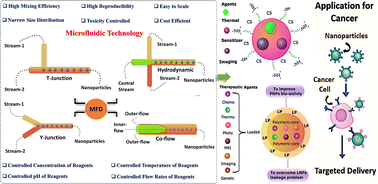
Organic nanoparticles can play an integral role in the biomedical field by optimizing the medication process in cancer treatment. They can ensure the non-toxic and target-specific delivery of a cancer-based antigen. Compared to conventional strategies, the microfluidic approach can ensure reproducible organic nanoparticles. The microfluidic approach can ensure the utmost controllability over reaction parameters and mixing performance. In this way, scientists can secure organic nanoparticles with a narrow size distribution and mono-dispersion. The microfluidic approach offers the chance for health scientists to secure industrial-scale productivity of organic nanoparticles. This review summarizes recent advancements in microfluidics for the synthesis of organic nanoparticles with relevant specifications. We emphasize the key fundamentals and the advantages of next-generation microfluidics over conventional strategies for the preparation of organic nanoparticles. Some positive and negative prospects that can affect the structural morphology and delivery of organic nanoparticles are highlighted. The developments in cancer-based therapies and administration routes via organic nanoparticles are also discussed briefly.
- This article is part of the themed collection: Recent Review Articles
 Please wait while we load your content...


