


Structural basis of glycoform selectivity in prion strains

Abstract
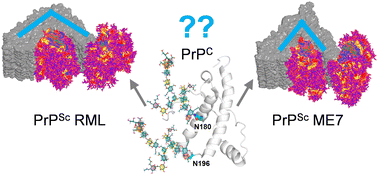
Prion diseases originate from the pathological misfolding of the cellular sialoglycoprotein prion protein (PrPC), universally found across mammalian species, into an aberrant conformation termed PrPSc, which exhibits high aggregation propensity and neurotoxicity. Distinct conformations of the misfolded and aggregated PrPSc, termed prion strains, can cause different disease phenotypes and transmission characteristics. Different prion strains exhibit well-defined and distinct glycoform preferences arising from two sialylated, N-linked glycans. Glycosylation, and in particular sialylation, have been demonstrated to modulate the replication rate of PrPSc, with profound implications for the propagation of prion diseases. In this work, we leverage high-resolution cryo-EM structural data and all-atom molecular dynamics simulations to elucidate the molecular basis of the glycoform preferences in mouse strains RML and ME7. We show that these preferences are determined by differential engagement of the major basic patch and palindromic region of PrP, shedding light on a long elusive, fundamental aspect of prion biology.
- This article is part of the themed collection: Celebration of the 70th birthday of Prof. Giuseppe Resnati
 Please wait while we load your content...


