Efficient direct phosphorylation of ribonucleosides by slightly soluble nickel phosphate mineral arupite, using wet/dry cycles

Ana Franco , Xuân-An Nguyen , José R. Ascenso and José A. L. da Silva *
Centro de Química Estrutural, Institute of Molecular Sciences, Departamento de Engenharia Química, Instituto Superior Técnico, Universidade de Lisboa, Av. Rovisco Pais, 1049-001, Lisboa, Portugal. E-mail: pcd1950@tecnico.ulisboa.pt

Received 2nd September 2025 , Accepted 16th October 2025

First published on 17th October 2025


Abstract

Phosphorylation of all canonical ribonucleosides was achieved with yields up to 31% using a slightly soluble source of nickel phosphate, arupite, Ni3(PO4)2·8H2O, after 28 wet/dry cycles, for 14 days (at 90 °C, in the presence of borate and urea in aqueous solution). This mineral could form under prebiological environments, and it is much more efficient than hydroxyapatite in phosphorylation reactions, under similar conditions. The samples were analyzed by 31P and 13C DEPT-135 NMR. These results suggest how phosphorylation of early molecules associated with the origin of life could have efficiently occurred in aqueous environments.
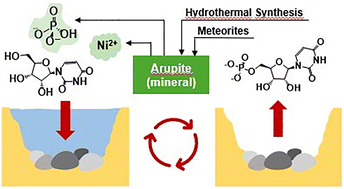

Efficient phosphorylation of abiotic molecules based on suitable prebiological sources of phosphate is an important topic of prebiotic chemistry. The clarification of this step of prebiological evolution is relevant to reinforce the RNA world hypothesis,1 the most widely accepted model2 for the explanation of the origin of life. Within it, the phosphorylation of ribonucleosides is one of the most important reactions, since it is a key step for the abiotic syntheses of ribonucleotides.3–7

In a prebiological environment, minerals containing a source of phosphate would have been plausible reagents in ribonucleoside phosphorylation. Due to their relative abundance, apatites Ca5(PO4)3(Cl/F/OH), are widely accepted as the most probable mineral source of prebiotic phosphate.8 However, their low solubility limits direct phosphorylation reactions in water; previously, we reported that phosphorylation can be carried out with hydroxyapatite Ca5(PO4)3(OH) in aqueous medium, using wet/dry cycles, but with very low yield.9 Low solubility or insolubility in water is a common property of most metal phosphate minerals.10 Additionally, despite life on Earth is water based, many prebiological reactions require dehydration and thus are endergonic in water.11,12 To remove these impediments, phosphorylation reactions of ribonucleosides with metal phosphate minerals (e.g. hydroxyapatite Ca5(PO4)3OH,13,14 newberyite MgHPO4·3H2O,15 vivianite Fe2+Fe2+2(PO4)2·8H2O,15 libethenite Cu2(PO4)(OH) and other copper phosphates16) are usually carried out in highly concentrated solutions of urea,13,17 non-aqueous (formamide)14,16,18 or semi-aqueous solvents (UWFA, a mixture of urea, ammonium formate and water).15

Herein we report that arupite Ni3(PO4)2·8H2O, a nickel phosphate weathering mineral occurring in nickel-rich iron meteorites, formed under hydrothermal conditions,19 and likely present in a prebiological environment, would have been an efficient reagent in the abiotic phosphorylation of the four canonical ribonucleosides, in aqueous medium.

We started by carrying out phosphorylation reactions of uridine and adenosine, with arupite Ni3(PO4)2·8H2O, parahopeite Zn3(PO4)2·4H2O and copper(II) phosphate Cu3(PO4)2·3H2O (precursor of libethenite, Cu2(PO4)(OH)),20 as a mineral source of phosphate. Previous studies indicate that different metal ions influence the results of phosphorylation,13–16,21 and it has been proposed that some divalent cations may play an important role in mobilizing phosphate from mineral sources, in small amounts of water.15 Among them, Ni2+, Cu2+ and Zn2+ are particularly interesting since they typically form complexes with similar stability, where Cu2+ usually has the highest stability constants (as described by the Irving–Williams series).22 Phosphorylation reactions were run following a similar method we previously reported;9 to an aqueous solution of ribonucleoside (uridine or adenosine) with borate, we added urea and a metal phosphate (Ni3(PO4)2·8H2O, Zn3(PO4)2·4H2O or Cu3(PO4)2·3H2O) in the solid state, with molar ratios ribonucleoside[thin space (1/6-em)]:[thin space (1/6-em)]B(OH)4[thin space (1/6-em)]:[thin space (1/6-em)]urea[thin space (1/6-em)]:[thin space (1/6-em)]PO43− of 1[thin space (1/6-em)]:[thin space (1/6-em)]0.5[thin space (1/6-em)]:[thin space (1/6-em)]3[thin space (1/6-em)]:[thin space (1/6-em)]2. While urea activates phosphate, borate promotes the stereoselective synthesis of 5′-ribonucleotides by binding to ribose moiety C2′ and C3′ positions, forming monoesters and diesters with each ribonucleoside, at pH ≥ 8.9,17,18 This also increases the solubility of guanosine and adenosine, which have low solubility in water. Every aqueous sample was then submitted to 14 wet/dry cycles, where evaporated water was replaced after ca. 12 h at 90 °C, with a 10 h long dry period duration. After 7 days, inorganic phosphate and UMP (Fig. 1) or vestiges of AMP (Fig. S1, SI) were detected at 2.5 and 3.7 ppm, respectively, by 31P NMR spectroscopy in samples with arupite. This indicates arupite was solubilized, leading to the subsequent formation of ribonucleotides. No signals were detected in any of the samples with other metal phosphates, including no phosphate was solubilized.


image file: d5nj03523f-f1.tif
Fig. 1 31P NMR spectra of uridine after 14 wet/dry cycles (ca. 10 h dry period) at 90 °C with borate, urea and (from top to bottom) arupite Ni3(PO4)2·8H2O, parahopeite Zn3(PO4)2·4H2O and copper(II) phosphate Cu3(PO4)2·3H2O, respectively.

Given these results, we tested arupite as a reagent in the phosphorylation of four canonical ribonucleosides (uridine, cytidine, guanosine and adenosine). Reactions were carried out in similar conditions to the described above, but submitting each sample to 28 wet/dry cycles. After 14 days at 90 °C, 31P NMR spectra (Fig. 2) showed that arupite had been solubilized in aqueous medium (inorganic phosphate with signal at 2.5 ppm) in every ribonucleoside sample, and promoted the synthesis of UMP, CMP, GMP and AMP (signals at 3.7 ppm). The formation of UMP, CMP and AMP is supported by 13C DEPT-135 spectra of samples of uridine, cytidine and adenosine (Fig. 3 and Fig. S5, S7, SI, respectively), which display signals of phosphorylated species with shifts at ca. 63.5 ppm, typical of ribonucleotides.23 Signals with shift values between 60 and 62 ppm are assigned to free ribonucleosides23 and their respective borate monoesters and diesters. e.g. In the case of uridine (Fig. 3), signals displayed at 60.7, 61.5 and 61.8 ppm are assigned to uridine, uridine–borate monoester (UBM) and uridine-borate diester (UBD), respectively. Other ribonucleosides form similar structures.


image file: d5nj03523f-f2.tif
Fig. 2 31P NMR spectra of (from top to bottom) guanosine, adenosine, cytidine, and uridine, respectively, after 28 wet/dry cycles (ca. 10 h dry period) at 90 °C with borate, arupite and urea. Signals are normalized to inorganic phosphate signal.

image file: d5nj03523f-f3.tif
Fig. 3 13C DEPT-135 NMR spectrum of uridine after 28 cycles (10 h dry period) at 90 °C with borate, arupite and urea (magnified from Fig. S2 and showing only signals of CH2 group of each species). Cr(acac)3 was used as relaxation agent. UBM and UBD represent uridine-borate monoesters and uridine-borate diesters, respectively.

Yields of phosphorylation varied in the order uridine > cytidine > adenosine, with overall yield of 31, 13 and 6% for UMP, CMP and AMP, respectively.

Reaction yields were determined by 13C DEPT-135 NMR spectroscopy, following a similar method described by Vlahov et al.,24 but using Cr(acac)3 as a relaxation agent (Sections S2.2.1 and S2.2.2, SI). Results are summarized in Table 1.

Table 1 Yields of the phosphorylated species in the reactions of the four canonical ribonucleosides (uridine, cytidine, adenosine and guanosine) with arupite, borate and urea, at 90 °C for 28 wet/dry cycles (10 h long dry period duration)
Ribonucleoside Reaction yield (%) (phosphorylated species) Overall yield (%)
a Reaction yield determined by 31P NMR; for other ribonucleosides, yields were determined by 13C DEPT-135.
Uridine UMP1 13 31
UMP2 12
UMP3 6.0
Cytidine CMP1 8.0 13
CMP2 5.0
CMP3
Adenosine AMP1 6.0 6.0
AMP2
AMP3
Guanosinea GMP 25


Conversely, 13C DEPT-135 NMR spectra of guanosine samples displayed no significant signals. This may be due to guanosine distinct tendency to form self-assembled structures,25i.e. hydrogels.26 However, chemical shift value displayed in 31P NMR spectra of guanosine (ca. 3.7 ppm, Fig. 2) indicates the formation of GMP.

Therefore, in this case, the phosphorylation yield was determined by 31P NMR spectroscopy, following a similar method we previously reported9 (Section S2.2.3, SI). Since Ni2+ leads to a slight broadening of the signals in 31P NMR spectra, the resulting 25% (Table 1) is an approximate yield. As aforementioned, different metal cations affect ribonucleoside phosphorylation and reaction yield.13–16,21 Different affinities between different metal ions and ribonucleoside, and the potential metal-binding sites in which complexes can be formed, may influence the solubilization of phosphate minerals in water. While no phosphate solubilization was observed when Cu2+ or Zn2+ minerals were used (Fig. 1), calculations show that at least 40% of phosphate (phosphorylated species not included) contained in arupite, was solubilized during the phosphorylation reaction of guanosine (Section S2.2.4, SI). Hence, Ni2+ promotes phosphate solubilization and, consequently, phosphorylation is possible, when compared to other metal cations. On the other hand, we observed that hydroxyapatite Ca5(PO4)3OH (the most common and natural source of phosphate) was also solubilized in water when we ran phosphorylation reactions with uridine (the most reactive ribonucleoside), for 28 wet/dry cycles at 90 °C, in similar conditions. While inorganic phosphate and UMP were detected by 31P NMR spectroscopy (Fig. S10, SI), at 2.5 and 3.7 ppm, respectively, the yield of phosphorylation was significantly lower (9.4% of UMP; determined by 13C DEPT-135 spectroscopy Fig. S12 and Table S3, SI) than with arupite. This may occur because Ca2+ has a lower affinity to bind to ribonucleosides and their derivatives than Ni2+.27 It is also important to note that hydroxyapatite has a low Ksp value (3.55 × 10–55)28 when compared with arupite, parahopeite and copper(II) phosphate (Ksp of 4.74 × 10⁻³², 1.4 × 10−37 and 9.1 × 10⁻³³, respectively)28 and consequently, lower solubility than these phosphates under our experimental conditions.

Alternatively, phosphorylation yield is improved by using wet/dry cycles as reaction procedure.4,9 This type of process could have occurred in prebiological dry lakes (flat basins in arid regions that would have periodically filled with water, followed by evaporation) or hydrothermal vents.29 Herein we report that an increase in dry period duration enhances the efficiency of phosphorylation with arupite (Fig. 4). When we decreased the dryness period of the cycles from 10 to 2 h in phosphorylation reactions of uridine, we observed a significant decrease in the intensity of the signal of UMP in its respective 31P NMR spectra (Fig. 4). Longer dry period also seems to be effective at lower temperatures, since traces of UMP were detected in the phosphorylation of uridine with arupite at 50 °C (Fig. S9, SI).


image file: d5nj03523f-f4.tif
Fig. 4 Effect of dry period duration in wet/dry cycles on ribonucleoside phosphorylation. The 31P NMR spectra were obtained from a sample of uridine after 28 wet/dry cycles at 90 °C, where each dry period lasted 10 h (top) and 2 h (bottom), respectively. Both reactions were carried out with arupite, borate and urea. Signals are normalized to inorganic phosphate signal.

Given these results, we suggest that mineral phosphate (particularly arupite) solubilization in water, and consequent efficient direct phosphorylation of ribonucleosides, depend on two factors: the nature of the metal cation and the dry stage length of the wet/dry cycles.

We suggest that, in a prebiological environment, wet/dry cycles would provide suitable media to enhance the formation of complexes between Ni2+ and ribonucleosides during the wet period of a cycle, thus facilitating phosphate solubilization in water. Experiments carried out with uridine without dry stage, in the absence of borate and urea, show that solubilization of phosphate occurs during the wet stage, only in the case of arupite (Fig. S13, SI). This effect could be promoted by the smaller ionic radius of Ni2+ (69 pm) when compared to other metal cations present in Cu3(PO4)2·3H2O or Zn3(PO4)2·4H2O (73 and 74 pm for Cu2+ and Zn2+, respectively).10 On the other hand, charge +2 should activate the ribonucleoside, favouring direct phosphorylation during the dry period of the cycle, enhancing yield the longer it lasts. In the case of hydroxyapatite Ca5(PO4)3OH, while Ca2+ has a higher ionic radius than Cu2+ and Zn2+, i.e. 100 pm,10 it tends to bind to O- instead of N-donors of ribonucleosides.27 Ni2+ prefers N-donors,27 consequently, significantly influencing solubilization of arupite.

Hence, despite its low solubility, arupite Ni3(PO4)2·8H2O could have acted as an efficient source of phosphate in a prebiological environment. However, it is important to analyse its occurrence during early Earth. In 2012, Hazen et al.30 estimated that 16.3% of known nickel minerals occurred in the Hadean, mostly formed by meteorite or hydrothermal alteration. The higher quantity of nickel in the primitive Earth's crust31 and the contribution of meteorites during the period of Late Heavy Bombardment support nickel participation during early steps of prebiological evolution.31,32

Other metal phosphate minerals (e.g. vivianite Fe2+Fe2+2(PO4)2·8H2O) could have been relevant in primordial phosphorylations in aqueous medium. Iron complexes have stability constants closer to nickel and much higher than calcium,22 and the addition of iron species significantly increases the yield of phosphorylation of ribonucleosides.15

Finally, we have observed that the presence of Ni2+ in phosphorylation reactions seem to lead to the preferential formation of 5′-phosphorylated species in the presence of borate. Signals relating to side phosphorylation reactions on C2′ or C3′ are not discernible in any 31P or 13C DEPT-135 NMR spectra9,17,18,23 of the four canonical ribonucleosides (Fig. 2 and Fig. S2–S8, SI). While it has been shown that borate favours phosphorylation in position C5′, side reactions are common and expected to occur in low yield.4 These results suggest that some metals, like Ni2+, may favour the formation of ribonucleotide-borate species. On the other hand, Ni2+ may promote the synthesis of ribonucleoside triphosphates, in the presence of borate and trimetaphosphate;21 and recent studies suggest that basalt glasses could have catalysed the formation of RNA from ribonucleoside-5′-triphosphates, on early Earth.33 Elucidation of the formation of these metal-ribonucleotide-borate complexes, in abiotic environments, could be an important step in the clarification of prebiological evolution.

This work was supported by the Fundação para a Ciência e a Tecnologia (FCT), Portuguese Agency for Scientific Research, through the program UIDB/00100/2020 (https://doi.org/10.54499/UIDB/00100/2020), UIDP/00100/2020 (https://doi.org/10.54499/UIDP/00100/2020), UI/BD/152238/2021 (https://doi.org/10.54499/UI/BD/152238/2021) and LA/P/0056/2020 (https://doi.org/10.54499/LA/P/0056/2020).

Author contributions

A. Franco: investigation, validation, visualization & writing – original draft. X. A. Nguyen: investigation & validation. J. R. Ascenso: formal analysis and supervision. J. A. L. da Silva: conceptualization, formal analysis, supervision & project administration. All authors contributed to writing – review & editing.

Conflicts of interest

The authors have no conflicts to declare.

Data availability

The authors confirm that the data supporting the findings of this study are available within the article and its supplementary information (SI). Supplementary information: supporting data including experimental methods, supporting figures, and tables referenced in the main text have been included as part of the SI. See DOI: https://doi.org/10.1039/d5nj03523f.

References

  1. W. Gilbert, Nature, 1986, 319, 618 CrossRef.
  2. H. S. Bernhardt, Biol. Direct, 2012, 7, 23 CrossRef PubMed.
  3. N. Kitadai and S. Maruyama, Geosci. Front., 2017, 9, 1117–1153 CrossRef.
  4. A. Franco and J. A. L. da Silva, Angew. Chem., Int. Ed., 2020, 133, 10550–10560 CrossRef.
  5. X. Guo, S. Fu, J. Ying and Y. Zhao, Open Biol., 2023, 13, 220234 CrossRef PubMed.
  6. M. Gull, Challenges, 2014, 5, 193–212 CrossRef.
  7. C. Fernández-García, A. J. Coggins and M. W. Powner, Life, 2017, 7, 31 CrossRef PubMed.
  8. K. Follmi, Earth-Sci. Rev., 1996, 40, 55–124 CrossRef.
  9. A. Franco, J. R. Ascenso, L. Ilharco and J. A. L. da Silva, New J. Chem., 2020, 44, 2206–2209 RSC.
  10. R. Chang and K. Goldsby, Chemistry, McGraw-Hill Education, New York, 2015 Search PubMed.
  11. M. A. Pasek and T. P. Kee, in On the Origin of Phosphorylated Biomolecules, Origins of Life: The Primal Self-Organization, ed. R. Egel, D.-H. Lankenau and A. Y. Mulkidjanian, Springer, Berlin, 2011, pp. 57–84 Search PubMed.
  12. A. G. de Herrera, T. Markert and F. Trixler, Commun. Chem., 2023, 6, 69 CrossRef PubMed.
  13. R. Lohrmann and L. E. Orgel, Science, 1971, 171, 490–494 CrossRef PubMed.
  14. B. Burcar, M. Pasek, M. Gull, B. J. Cafferty, F. Velasco, N. V. Hud and C. Menor-Salván, Angew. Chem., Int. Ed., 2016, 55, 13249–13253 CrossRef.
  15. B. Burcar, A. Castañeda, J. Lago, M. Daniel, M. A. Pasek, N. V. Hud, T. M. Orlando and C. Menor-Salván, Angew. Chem., Int. Ed., 2019, 58, 16981–16987 CrossRef.
  16. G. Costanzo, R. Saladino, C. Crestini, F. Ciciriello and E. Di Mauro, J. Biol. Chem., 2007, 282, 16729–16735 CrossRef PubMed.
  17. H. Kim, Y. Furukawa, T. Kakegawa, A. Bita, R. Scorei and S. A. Benner, Angew. Chem., Int. Ed., 2016, 128, 16048–16052 CrossRef.
  18. Y. Furukawa, H.-J. Kim, D. Hutter and S. A. Benner, Astrobiology, 2015, 15, 259–267 CrossRef CAS.
  19. A. V. Ivanov, A. A. Yaroshevskiy and M. A. Ivanova, Geochem. Int., 2019, 57, 931–939 CrossRef CAS.
  20. M. Ouchabi, M. Baalala, A. Elaissi and M. Bensitel, J. Mater. Environ. Sci., 2016, 7, 1417–1424 CAS.
  21. H.-J. Kim and S. A. Benner, Astrobiology, 2021, 21, 298–306 CrossRef CAS.
  22. J. J. R. F. da Silva and R. J. P. Williams, The biological chemistry of the elements, Oxford University Press, Oxford, 2001 Search PubMed.
  23. SDBS: Spectral Database for Organic Compounds. National Institute of Advanced Industrial Science and Technology (AIST). https://sdbs.db.aist.go.jp/, (accessed May 2025).
  24. G. Vlahov, C. Schiavone and N. Simone, Magn. Reson. Chem., 2001, 39, 689–695 CrossRef CAS.
  25. G. M. Peters and J. T. Davis, Chem. Soc. Rev., 2016, 45, 3188–3206 RSC.
  26. G. M. Peters, L. P. Skala, T. N. Plank, H. Oh, G. N. M. Reddy, A. Marsh, S. P. Brown, S. R. Raghavan and J. T. Davis, J. Am. Chem. Soc., 2015, 137, 5819–5827 CrossRef CAS.
  27. S. A. Kazakov and S. M. Hecht, in Encyclopedia of Inorganic and Bioinorganic Chemistry, Nucleic acid–metal ion interactions, ed. R. A. Scott, John Wiley & Sons, Inc., New Jersey, 2005, ISBN 978-1-119-95143-8 Search PubMed.
  28. J. Rumble, in CRC Handbook of Chemistry and Physics: A Ready-reference Book of Chemical and Physical Data, ed. J. R. Rumble, D. R. Lide and T. J. Bruno, CRC Press, Boca Raton, 2018 Search PubMed.
  29. A. Franco, M. O. Neves and J. A. L. da Silva, Astrobiology, 2023, 23, 605–615 CrossRef CAS.
  30. R. M. Hazen, Am. J. Sci., 2013, 313, 807–843 CrossRef CAS.
  31. K. O. Konhauser, E. Pecoits, S. V. Lalonde, D. Papineau, E. G. Nisbet, M. E. Barley, N. T. Arndt, K. Zahnle and B. S. Kamber, Nature, 2009, 458, 750–753 CrossRef CAS.
  32. R. Hengeveld and M. A. Fedonkin, Acta Biotheor., 2007, 55, 181–226 CrossRef CAS.
  33. C. A. Jerome, H.-J. Kim, S. J. Mojzsis, S. A. Benner and E. Biondi, Astrobiology, 2022, 22, 629–636 CrossRef CAS PubMed.

This journal is © The Royal Society of Chemistry and the Centre National de la Recherche Scientifique 2025
Click here to see how this site uses Cookies. View our privacy policy here.