Yoshiaki Ukita, Yuichi Utsumi and Yuzuru Takamura
Anal. Methods, 2016,8, 256-262
DOI:
10.1039/C5AY01969A,
Paper


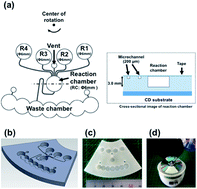
This study reports the first demonstration of an enzyme-linked immunosorbent assay (ELISA) using a microfluidic device that was fabricated in a three-dimensional (3D) printer. The centrifugal microfluidic device is driven by a mini-centrifuge realized fluidic control for the ELISA, including the injection of a reagent, incubation and reaction, and washing and draining of the reagent, by simply applying the reagent and spinning the device. The analysis of the reaction was accomplished by smartphone-based colorimetric measurements using a free application, and the results suggest that the microfluidic device followed by the use of the smartphone application showed a detection limit (0.89 ng ml−1) that was comparable with conventional absorbance measurements (0.96 ng ml−1) using a plate reader. Therefore, our results suggest that widely available equipment, such as mini-centrifuges, smartphones, and, in the near future, 3D printers, can potentially contribute to the commercialization of the microfluidic immunoassay system.