


π frameworks: emerging porous supramolecular framework materials for photocatalysis
 *a
and
Tong-Bu
Lu
a
*a
and
Tong-Bu
Lu
a
Abstract
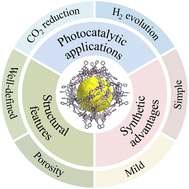
π frameworks, as a class of porous supramolecular materials constructed from conjugated molecular building blocks via π–π stacking interactions, have opened up a novel avenue for the advancement of photocatalysis. Compared with traditional inorganic or polymeric photocatalysts, π frameworks offer remarkable advantages, encompassing inherently well-defined crystalline structures, tunable molecular configurations, and superior light-harvesting capacities. Notably, their ordered crystalline architectures provide invaluable insights into the structure–property relationships that govern catalytic performance. Despite the fact that current research on π frameworks for photocatalytic applications is still in its nascent stage, a systematic review summarizing their synthetic strategies, structural design, and major catalytic applications would significantly facilitate the progression of this field. In the present review, we comprehensively recapitulate recent advances in the research and application of π frameworks, with a particular focus on their utilization in photocatalysis. Furthermore, we elaborate on the intrinsic correlation between framework structures and photocatalytic properties. Finally, we address the prevailing challenges and delineate critical issues that need to be resolved to fully unlock the potential of π frameworks in photocatalytic applications.
- This article is part of the themed collection: Journal of Materials Chemistry A Recent Review Articles
 Please wait while we load your content...


