


Spatially directed charge transfer in a polymer framework for efficient photocatalytic overall water splitting

Abstract
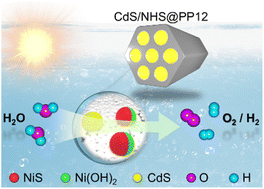
Solar-driven photocatalytic overall water (H2O) splitting (OWS) offers a sustainable route for hydrogen (H2) production, yet current systems suffer from low production rate (<1 mmol h−1) that impede commercialization. Herein, we integrate a cadmium sulfide (CdS) light harvester and a dual-cocatalyst (NHS) composing of nickel (Ni) hydroxide and nickel sulfide into a porous polymer framework (PP12), constructing a CdS/NHS@PP12 system. CdS/NHS@PP12 achieves a sustained, violent bubbling H2 production from photocatalytic OWS at an unprecedented evolution rate of 125.3 mmol h−1, representing a 50-fold enhancement over state-of-the-art benchmarks. Mechanistic investigations reveal that the atomically dispersed oxygen (O) and nitrogen (N) sites in PP12 function as coordinated charge-steering relays, facilitating spatially directed charge transfer to active sites on NHS via Ni–N and Ni–O coordination. This enhances photocatalytic OWS in CdS/NHS@PP12. Furthermore, CdS/NHS@PP12 has exceptional stability, modular scalability and robust resilience against ionic impurities. These findings provide a scalable and high-performance strategy for solar-to-hydrogen conversion.
- This article is part of the themed collection: 2026 Chemical Science HOT Article Collection
 Please wait while we load your content...


