


Advances in ionic liquid recycling for lignocellulosic biomass pretreatment

Abstract
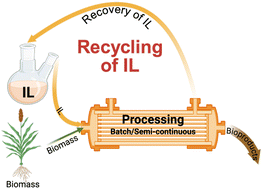
Ionic liquids (ILs) are promising solvents for the pretreatment of lignocellulosic biomass due to their ability to disrupt cellulose, hemicellulose, and lignin structures. However, large-scale implementation requires the development of efficient recovery and recycling methods. This review provides a comprehensive analysis of the recyclability potential of ILs used in biomass pretreatment, emphasizing their mechanisms, recent innovations, and ongoing challenges. We begin by discussing the structural diversity and tunability of ILs, which underlie their effectiveness in biomass deconstruction. The distinct roles of IL anions and cations in dissolving specific biomass components are systematically presented and compared. Advances in IL recycling techniques, including antisolvent precipitation methods, membrane separation, and distillation, are critically examined, with attention to how mechanistic insights can inform the design of more efficient and selective recovery strategies. Despite progress, significant challenges remain to scaling up IL-based biomass processing, including high cost, environmental concerns, and impact of biomass-derived impurities (e.g., lignin residues, sugars, proteins) on IL purity and functionality after reuse. We also review the applicability of different ILs based on life cycle assessments and techno-economic analyses. Lastly, we identify critical research gaps and propose future directions, including the design and development of next-generation ILs with improved recyclability, reduced toxicity, and enhanced economic viability for industrial-scale applications.
- This article is part of the themed collections: 2025 Green Chemistry Covers and 2025 Green Chemistry Reviews
 Please wait while we load your content...


