Congcong Zhao, Jiuxing Wang, Jiqing Jiao, Linjun Huang and Jianguo Tang
J. Mater. Chem. C, 2020,8, 28-43
DOI:
10.1039/C9TC05567C,
Review Article


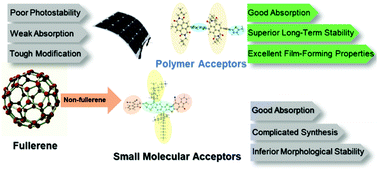
In the past few decades, polymer solar cells (PSCs) have been intensively investigated in academic fields. The study of non-fullerene polymer acceptors has become a hot research focus due to their excellent opto-electronic properties such as wide light-absorbing ability, appropriate molecular energy levels, and easy chemical modifications. The much higher power conversion efficiencies (PCEs) of non-fullerene PSCs relative to fullerene PSCs revealed the significant potential of non-fullerene acceptors in PSCs. This review systematically summarizes the recent advancements of efficient polymer acceptors, including perylene diimide-based, naphthalene diimide-based, diketopyrrolopyrrole-based, double B←N bridged bipyridyl-based, and other polymer acceptors. Their structure–property relationships were thoroughly analyzed and summarized, which may provide new guidance for the rational structural design of high-performance photovoltaic materials.