



Nocturnal vertical gradients in O3, PAN and PAA in a boreal forest: the role of chemical reactions, deposition and entrainment
 *a
Carolina
Nelson,
a
Patrick
Dewald,
a
Tuukka
Petäjä,
b
Ilona
Ylivinkka,
bc
Robby
Rynek,
d
Helko
Borsdorf,
d
John N.
Crowley
*a
*a
Carolina
Nelson,
a
Patrick
Dewald,
a
Tuukka
Petäjä,
b
Ilona
Ylivinkka,
bc
Robby
Rynek,
d
Helko
Borsdorf,
d
John N.
Crowley
*a
Abstract
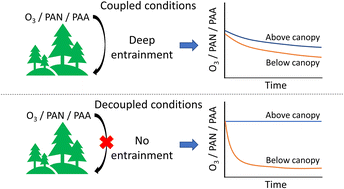
The complex interplay between different processes (physical losses, chemical losses and entrainment) defines the vertical gradient of many trace gases in forested environments. Despite this, height-resolved measurements of trace gases within a forest canopy are scarce. We present measurements of O3, PAN (peroxy acetyl nitric anhydride, CH3C(O)OONO2), and PAA (peroxy acetic acid, CH3C(O)OOH) at 6 heights between 1 and 28 m above and below the canopy at the SMEAR II site in the Finnish boreal forest. Through analysis of O3, PAN, and PAA nocturnal time-series we derived their height-dependent net loss rate coefficients. The net lifetimes of O3, PAN and PAA were highly variable with values of 1.5–42 h, 1.0–29 h, and 0.7–15 h, respectively, with the shortest lifetimes often measured at the lowest heights. The relative loss rates of PAN or PAA compared to O3 (kPAN/kO3 and kPAA/kO3) varied between 1.0–3.0 (85% of the measurements) and 1.0–5.0 (78% of the measurements) with medians of 1.7 and 2.4, respectively. The physical loss of O3, PAN and PAA was the major loss process (>90%), with chemical losses playing only a minor role. Entrainment significantly compensated for the physical and chemical losses and led to reduced net loss values of each trace gas, with exceptions encountered on a few nights when the sub-canopy and above-canopy air masses were decoupled as a result of e.g. low wind speed and friction velocity. Our vertical profiles of O3, PAN, and PAA reveal the complex interplay of boundary layer dynamics and chemistry at this forested location.
- This article is part of the themed collection: HOT articles from Environmental Science: Atmospheres
 Please wait while we load your content...


