


Deformable metal–organic nanosheets@SiO2 core–shell for heterogeneous tandem catalytic transformations

Abstract
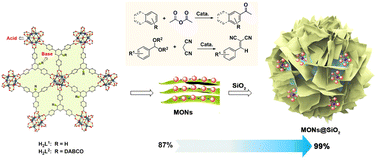
Overcoming mass transport limitations imposed by stagnant boundary layers is critical for advancing heterogeneous catalysis. Building upon strategies utilizing deformable metal–organic nanosheets (MONs) to enhance diffusion, we report the synthesis of well-defined core–shell microspheres that integrate flexible and functional two-dimensional MONs. Nonporous carboxyl-terminated SiO2 nanoparticle cores are seamlessly enveloped by ultrathin Zr-MON shells through a facile bottom-up approach. The resulting MON@SiO2 architecture exposes abundant coordinatively unsaturated Zr(IV) Lewis acid sites on its deformable nanosheets. Further introduction of the triethylenediamine (DABCO) moieties into the MON produces MON-DABCO@SiO2, enabling the co-existence of isolated Lewis acid and base sites amenable to promoting challenging reactions that are unachievable by homogeneous systems. These dynamic core–shell structures significantly enhance molecular diffusion to the active sites, as evidenced by ultra-efficient catalysis (>99% yield) in the one-pot hydrolysis-Knoevenagel tandem reactions across broad-scope substrates. Importantly, the SiO2 core confers exceptional structural durability, enabling great catalytic recyclability for at least 5 consecutive cycles without any degradation of the performances, which is in stark contrast to the unsupported MONs. This work therefore establishes core–shell engineering of deformable MONs as a versatile approach for architecting high-performance and durable heterogeneous catalysts by synergistically combining enhanced mass transport with nanoconfinement effects.
- This article is part of the themed collection: 2025 Nanoscale HOT Article Collection
 Please wait while we load your content...


