


Thermally activated delayed fluorescence materials for nanomaterial-based light-emitting diodes

Abstract
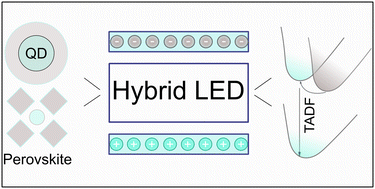
The emergence of materials that exhibit thermally activated delayed fluorescence (TADF) has revolutionized the development of light-emitting diodes (LEDs). TADF involves a reverse intersystem crossing transition of excitations from a triplet to a closely lying singlet state, followed by radiative emission. This phenomenon enables the effective utilization of triplet excitations for light generation, achieving up to 100% internal quantum efficiency in devices. The ability to efficiently harvest all excitations has spurred the rapid development of new types of LEDs, in which TADF-active materials enhance or sensitize emission from other luminophores. This review focuses on the development and application of hybrid systems comprising TADF materials and inorganic emitters, such as semiconductor quantum dots and perovskite nanostructures. After providing a concise overview of these materials’ properties, we systematically examine how TADF materials can improve the optical, electronic, and morphological characteristics of inorganic emissive layers. This ultimately improves the performance and stability of devices based on these systems and paves the way for next-generation LED systems.
- This article is part of the themed collection: Recent Review Articles
 Please wait while we load your content...


