


Fully conjugated D–A COFs with thiadiazole and thiazolothiazole linkers: tailoring electronic structures for efficient metal-free and Pt-assisted hydrogen evolution

Abstract
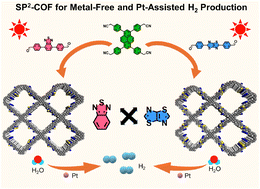
Developing efficient photocatalysts for both metal-free and noble-metal-assisted systems is essential for sustainable hydrogen production. Herein, we report two fully π-conjugated donor–acceptor covalent organic frameworks (COFs), Py-CN-BZTD and Py-CN-TZTZ, constructed via cyano-vinylene linkages from pyrene (Py) donors and thiadiazole (BZTD) and thiazolothiazole (TZTZ) acceptors. Both COFs show high crystallinity, stability, and tunable electronic structures. Py-CN-BZTD, with a narrower bandgap (2.06 eV), delivers a higher metal-free hydrogen evolution rate (12 200 µmol g−1 h−1) than Py-CN-TZTZ (7652 µmol g−1 h−1) under visible light. Upon loading 1 wt% Pt, Py-CN-TZTZ exhibits a greatly enhanced HER of 61 577 µmol g−1 h−1, which is among the highest reported values for COF-based photocatalysts to date, surpassing Py-CN-BZTD (26 016 µmol g−1 h−1). EPR (DMPO/TEMPO) and DFT analyses reveal that Pt more efficiently extracts electrons and promotes charge transfer in Py-CN-TZTZ, overcoming its less favorable intrinsic charge separation. This work demonstrates how heteroatom linker engineering and band structure tailoring synergistically control photocatalytic performance, offering valuable insights into the design of highly efficient COFs for both metal-free and Pt-assisted solar hydrogen production.
- This article is part of the themed collection: Advances in Sustainable Catalysis: from Materials to Energy and Environmental Applications
 Please wait while we load your content...


