


Synergistic Cu nanoparticles and Cu single atoms leveraging hydrogen spillover for selective CO electroreduction to acetate

Abstract
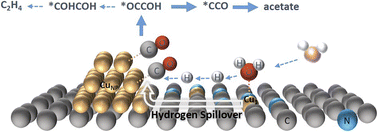
The electrochemical reduction of CO to acetate on Cu-based catalysts is constrained by a kinetic trade-off between CO activation and the availability of active hydrogen (*H) species. Herein, we overcome this limitation by constructing a synergistic catalyst comprising Cu nanoparticles and Cu single atoms (CuNP–Cu1), which leverages a hydrogen spillover mechanism. The Cu1 sites facilitate water dissociation to generate *H, which subsequently spills over to adjacent Cu NPs, enabling efficient hydrogenation of the *OCCO intermediate, with subsequent formation of *CCO selectively. This synergy delivers an acetate faradaic efficiency of 60.6% with an acetate partial current density of 111.1 mA cm−2 and stable operation for 132 h. Operando spectroscopy measurements and theoretical calculations collectively reveal that the Cu1-mediated hydrogen spillover shifts the reaction pathway toward acetate formation. This work establishes hydrogen spillover as a design principle for coordinating multistep reactions in CO electroreduction.
- This article is part of the themed collection: 15th Anniversary: Chemical Science Leading Investigators collection
 Please wait while we load your content...


