


Controlling the fate of two triplet states: solid-state annihilator design for photon upconversion
 *abcde
Abstract
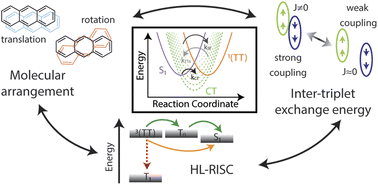
Photon upconversion, the process of converting low-energy light into higher-energy photons, offers transformative opportunities for energy conversion and optoelectronics. In this Perspective, we examine the molecular design principles of solid-state annihilators, emphasizing a unified excitonic framework that links upconversion with related technologies such as organic light-emitting diodes and singlet fission. We discuss key challenges, including controlling triplet exciton diffusion, maximizing singlet formation efficiency, and suppressing loss channels such as excimer and trap-state formation. Strategies that leverage precise intermolecular packing and tailored electronic coupling are highlighted as critical levers for dictating excited-state dynamics and optimizing photophysical outcomes. Looking forward, we propose that future breakthroughs will surpass the “solution-first approach” and hinge on integrating data-driven machine learning approaches with phonon engineering to rationally design materials with enhanced light emission and energy conversion efficiency. This framework provides guiding principles for the next generation of high-performance solid-state upconversion systems.
- This article is part of the themed collections: 2026 Chemical Science Perspective & Review Collection and 15th Anniversary: Chemical Science Leading Investigators collection
 Please wait while we load your content...


