Ryusei
Uozumi
a,
Takuto
Naito
a,
Hiroyoshi
Esaki
b,
Norihiro
Tada
*a and
Akichika
Itoh
*a
aGifu Pharmaceutical University, 1-25-4 Daigaku-nishi, Gifu 501-1196, Japan. E-mail: ntada@gifu-pu.ac.jp
bHyogo Medical University, 1-1 Mukogawa-cho, Nishinomiya, Hyogo 663-8501, Japan
First published on 18th September 2025
In this study, external base-free electrophilic diynylation of thiols to 1,3-butadiynyl sulfide, an important structural motif in organic synthesis, chemical biology, and materials science using triisopropylsilyl diynyl benziodoxolone at room temperature has been developed. Various thiols, such as cysteine and thioglucopyranose derivatives and captopril, were converted into the corresponding 1,3-butadiynyl sulfides. Control experiments and a computational study were performed to investigate the reaction mechanism. The resulting 1,3-butadiynyl sulfides were further derivatized to thiobitriazole via double azide–alkyne cycloaddition and to cyclobutene via [2 + 2] cycloaddition.
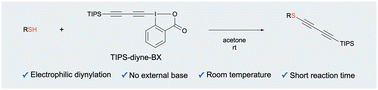
Driven by our interest in developing hypervalent iodine compounds and by the utility of 1,3-butadiyne in various fields,13,14 we recently reported triisopropylsilyl diynyl benziodoxolone (TIPS-diyne-BX) and copper-catalyzed electrophilic diynylation of sulfonamides using TIPS-diyne-BX.13a,b Structurally, TIPS-diyne-BX is a strong candidate for direct electrophilic diynylation of thiols under mild reaction conditions owing to the electron-withdrawing nature of the alkyne group (H–C
C: χ = 2.789, σp = 0.23; σp− = 0.53).7,15 This property likely stabilizes the transition state of α-addition of thiols, as suggested by Waser's mechanistic investigations (Scheme 1F).4d Furthermore, conjugation between the alkyne and ethynyl benziodoxolone likely lowers the lowest unoccupied molecular orbital (LUMO) energy of the EBX reagent,16 enhancing its reactivity without altering benziodoxolone, the leaving group. Herein, we report an external base-free electrophilic diynylation of thiols (Scheme 1F).
The reaction conditions for electrophilic diynylation of thiols using 4-bromobenzenethiol (1a) and TIPS-diyne-BX (2a) are summarized in Tables 1 and S1–S3, SI. Using tetramethylguanidine (TMG) as a base in THF, 1,3-butadiynyl sulfide 3a was obtained with a yield of 69%, with disulfide 4a (20%) as a minor product (entry 1).3 The investigation of additives and solvents (entries 2–11) revealed that the highest yield (81%) was achieved using Et3N as the base and EtOAc as the solvent (entry 7, Condition A). Notably, the reaction exhibited a good yield with a catalytic amount of Et3N (entry 8) and even in the presence of acetic acid, albeit with a modest yield (entry 11). A moderate yield of 3a (41%) was obtained in the absence of any additive (entry 12). This prompted an investigation into solvent effects without additives, which revealed that acetone afforded 3a in 79% yield, with disulfide 4a (13%) as a minor product, at room temperature (entry 16, Condition B). This reaction could be carried out under air and in wet acetone without any loss of efficiency (entries 17 and 18). Remarkably, it was completed within 5 min owing to the absence of 2a in the 1H NMR spectrum when acetone-d6 was used as the solvent (entry 19).
| Entry | Additive | Solvent | Yield (%) | |
|---|---|---|---|---|
| 3a | 4a | |||
| a Reaction conditions: 1a (0.05 mmol), 2a (1.1 equiv.), additive (1.2 equiv.), dried solvent (2 mL), rt, 30 min, argon. 1H NMR yields. Numbers in parentheses are isolated yields. b Et3N (0.2 equiv.) was used instead of Et3N (1.2 equiv.). c Under air. d Nondried acetone was used. e Reaction conditions: 1a (0.015 mmol), 2a (1.1 equiv.), acetone-d6 (0.6 mL), rt, <5 min, air. | ||||
| 1 | TMG | THF | 69 | 20 |
| 2 | TMG | DCM | 51 | 15 |
| 3 | TMG | Acetone | 59 | 16 |
| 4 | TMG | EtOH | 69 | 22 |
| 5 | TMG | EtOAc | 71 | 14 |
| 6 | DBU | EtOAc | 67 | 15 |
| 7 | Et 3 N | EtOAc | 79 (81) | 17 (19) |
| 8b | Et3N | EtOAc | 72 | 15 |
| 9 | K2CO3 | EtOAc | 72 | 16 |
| 10 | NaHCO3 | EtOAc | 47 | 48 |
| 11 | AcOH | EtOAc | 34 | 45 |
| 12 | — | EtOAc | 41 | 38 |
| 13 | — | EtOH | 41 | 25 |
| 14 | — | DCM | 44 | 28 |
| 15 | — | THF | 54 | 27 |
| 16 | — | Acetone | 80 (79) | 15 (13) |
| 17c | — | Acetone | 78 | 22 |
| 18d | — | Acetone | 76 | 21 |
| 19e | — | Acetone-d6 | (64) | (10) |
|
||||
With optimized conditions in hand, we examined the scope and limitations using various thiols (Scheme 2). para-Substituted benzenethiols bearing electron-donating or electron-withdrawing groups afforded the desired 1,3-butadiynyl sulfides in good yields (3b–3d). 2-Bromobenzenethiol also gave the product in good yield (3e). 7-Mercapto-4-methylcoumarin (1f), a heteroaryl thiol, provided the corresponding product in moderate isolated yield (3f). Meanwhile, 2-mercaptobenzoxazole (1g) provided product 3g in modest yield. Notably, 3g was obtained in lower yield (11%) under Condition A than under Condition B (39%). Primary and secondary aliphatic thiols delivered the desired sulfides in modest to good yields (3h–3k). In the case of 3j, formation of the disulfide product 4j (42%) was also observed, as revealed by the 1H NMR spectrum of the crude product. Under Condition A, 3i and 3j were obtained in the improved yields of 79% and 57%, respectively. The reaction of 1,2-ethanedithiol afforded the bis-1,3-butadiynyl sulfide 3l in high yield with 2.2 equivalents of 2a. More complex thiols were also compatible. A protected cysteine derivative yielded 3m in 81% yield, which increased to 89% on a 1 mmol scale, demonstrating the scalability of the method. Tetra-O-acetyl-1-thio-β-D-glucopyranose gave 3n in 55% yield, and captopril underwent diynylation in a mixed aqueous solvent (THF/H2O = 14
:
1) to afford 3o in modest isolated yield. These results highlight the versatility of the method, as hydroxy, carboxyl, carbamate, ester, and certain heterocyclic functionalities were well tolerated. However, 2-quinoline thiol, 2-(diethylamino)ethanethiol hydrochloride, and thiobenzoic acid provided a complex mixture, as observed in the 1H NMR spectrum, from which no products could be isolated, likely due to product instability (3p–3r).17
To probe the reaction mechanism, a series of control experiments were conducted (Table 2). Diynylation of 1h proceeded to provide 3h in a good yield under dark conditions using Conditions A and B (entries 3 and 4). By contrast, the presence of the radical scavenger 2,6-di-tert-butyl-p-cresol (BHT) under Condition B decreased the yield (54%) (entry 6), suggesting the involvement of a radical intermediate. Similarly, 4-bromobenzenethiol (1a) showed a reduced yield under dark conditions and in the presence of BHT with Condition B (Table S4, SI). By contrast, the cysteine derivative 1m showed consistent yields under all tested conditions (Table S5, SI). These results reveal that the reaction proceeds via an ionic mechanism under Condition A, whereas it proceeds predominantly via an ionic pathway with a partial contribution from a radical pathway for certain substrates under Condition B.
| Entry | Conditions | Yield (%) | |
|---|---|---|---|
| 3h | 4h | ||
| a Reaction conditions: Condition A: 1h (0.05 mmol), 2a (1.1 equiv.), Et3N (1.2 equiv.), EtOAc (2 mL), rt, 30 min, argon. Condition B: 1h (0.05 mmol), 2a (1.1 equiv.), acetone (2 mL), rt, 30 min, argon. 1H NMR yields. The number in parentheses is the isolated yield. | |||
| 1 | A | 81 | 10 |
| 2 | B | 79 (82) | 6 |
| 3 | A, under dark | 67 | 6 |
| 4 | B, under dark | 72 | 5 |
| 5 | A, with BHT (1.0 equiv.) | 73 | 8 |
| 6 | B, with BHT (1.0 equiv.) | 54 | 7 |
|
|||
To investigate the high reactivity of 2a in the absence of a base, various EBX reagents were evaluated under our reaction conditions (Table 3). TIPS-EBX (2b) afforded the corresponding product 3hb in low yield under both reaction conditions, with disulfide 4h as the major product (entries 3 and 4). Other electron-rich and neutral EBX reagents showed similar trends, producing lower yields of the corresponding thioalkynes (3hc–3he) without a base (entries 5–10). In contrast, 4-nitrophenyl-EBX gave the product in good yields even without a base (3hf: 81% and 67%) (entries 11 and 12).
| Entry | R | Conditions | Yield (%) | |
|---|---|---|---|---|
| 3 | 4h | |||
| a Reaction conditions: Condition A: 1h (0.05 mmol), 2 (1.1 equiv.), Et3N (1.2 equiv.), EtOAc (2 mL), rt, 30 min, argon. Condition B: 1h (0.05 mmol), 2 (1.1 equiv.), acetone (2 mL), rt, 30 min, argon. 1H NMR yields. Number in parentheses is isolated yield. | ||||
| 1 | TIPS-C C (2a) |
A | 3h: 81 | 10 |
| 2 | B | 3h: 79 (82) | 6 | |
| 3 | TIPS (2b) | A | 3hb: 29 | 61 |
| 4 | B | 3hb: 2 | 86 | |
| 5 | n Bu (2c) | A | 3hc: 50 | 32 |
| 6 | B | 3hc: 19 | 74 | |
| 7 | 4-MeO-C6H4 (2d) | A | 3hd: 40 | 47 |
| 8 | B | 3hd: 12 | 78 | |
| 9 | Ph (2e) | A | 3he: 23 | 65 |
| 10 | B | 3he: 17 | 59 | |
| 11 | 4-NO2-C6H4 (2f) | A | 3hf: 81 | 7 |
| 12 | B | 3hf: 67 | 9 | |
|
||||
To further understand the high reactivity of 2a, DFT calculations were performed on a series of the EBX reagents to analyze their LUMO energies and natural population charges. Notably, 2a exhibited a low LUMO energy (−0.03187 a.u.) (Fig. 1). The LUMO, comprising the I–C σ* orbital (σ-hole) of the hypervalent iodine center and the π* orbital of the diyne moiety, is mainly localized on the iodine atom and the α-carbon (Fig. 2). Among the EBX reagents studied, 2a showed the highest δ+ character at the iodine atom and the lowest δ− character at the α-carbon. These electronic features suggest that thiol coordination to the iodine atom and α-addition are both facilitated. The electron-withdrawing nature of the alkynyl group likely accounts for this charge distribution and the enhanced reactivity (H–C
C: χ = 2.789, σp = 0.23, σp− = 0.53) (Fig. 1).7,15 In addition, the low steric crowding around the iodine and α-carbon atoms in 2a owing to the presence of two adjacent alkynyl groups may explain the higher yield obtained with 2a than that with 2f, which has a planar 4-nitro-phenyl group. Waser previously reported that acyl-substituted EBX reagents (acyl-EBX), which contain a strongly electron-withdrawing acyl group (PhCO: σp = 0.43, σp− = 0.83) at the β-carbon, are unstable; thiols react with in situ-generated acyl-EBX to give ketene dithioarylacetals in the presence of a base.18
According to these results and previous reports, a plausible mechanism for the external base-free electrophilic diynylation of thiols is proposed (Scheme 3).3,4 The thiol coordinates to the iodine center of TIPS-diyne-BX (2a) without a base in the presence of the high δ+ character of the iodine atom to provide complex A. Ligand exchange produces intermediate Bvia proton transfer. The electron-withdrawing alkynyl group favors α-addition over β-addition, leading to intermediate DviaC, with the stabilization of the δ− character in C and D. Notably, vinyl benziodoxolone (S3h), likely formed via β-addition, was absent when a catalytic amount of Cs2CO3 was used in EtOH (Scheme S1, SI). Intermediate D undergoes β-elimination to afford product 3. However, the addition of the thiol to the α-carbon of 2a to the product through a single transition state without intermediates such as B and D, which were previously proposed for the reaction mechanism in the presence of a base, cannot be ruled out.4d Control experiments indicate that although the reaction generally follows an ionic pathway, some substrates may partially proceed via a radical mechanism under certain conditions.19
To demonstrate the synthetic utility of 1,3-butadiynyl sulfides, we explored chemoselective azide–alkyne cycloaddition at the thioalkyne site, using cysteine-derived compound 3m and glycine-derived azide 5a under various conditions.10a,13a,20 Optimal conditions were achieved with Cp*RuCl(cod) in MeCN at room temperature, affording 6a in good yield (Scheme 4 and Table S6, SI). This protocol was applied to the synthesis of 5-thiotriazoles containing N-acetylglucosamine, nucleoside, and pyrene moieties, delivering 6b–6d in good to high yields. Deprotection of the TIPS group in 6a afforded 7 in good yield, which subsequently underwent copper-catalyzed azide–alkyne cycloaddition with leucine-derived azide 8 to furnish thiobitriazole 9, a novel tripeptide analog, in 79% yield (Scheme 5).21 Furthermore, [2 + 2] cycloaddition with norbornadiene (10) in the presence of Cp*RuCl(cod) yielded cyclobutene 11 in high yield with a 1
:
1 diastereomeric ratio.22
![]() | ||
| Scheme 4 RuAAC with 1,3-butadiynyl sulfide. Reaction conditions: 3m (1.1 equiv.), 5 (0.05 mmol.), Cp*RuCl(cod) (4 mol%), MeCN (1 mL), rt, 18 h, argon. Isolated yields. | ||
| This journal is © The Royal Society of Chemistry 2025 |